aragoto
荒事
あらごとthe bold, heroic style of Edo kabuki
INSTANT ANSWER
Aragoto is the bold, larger-than-life acting style—said to have been created by Ichikawa Danjūrō I—in which heroes express superhuman power through striking makeup, oversized costumes, and dramatic poses.
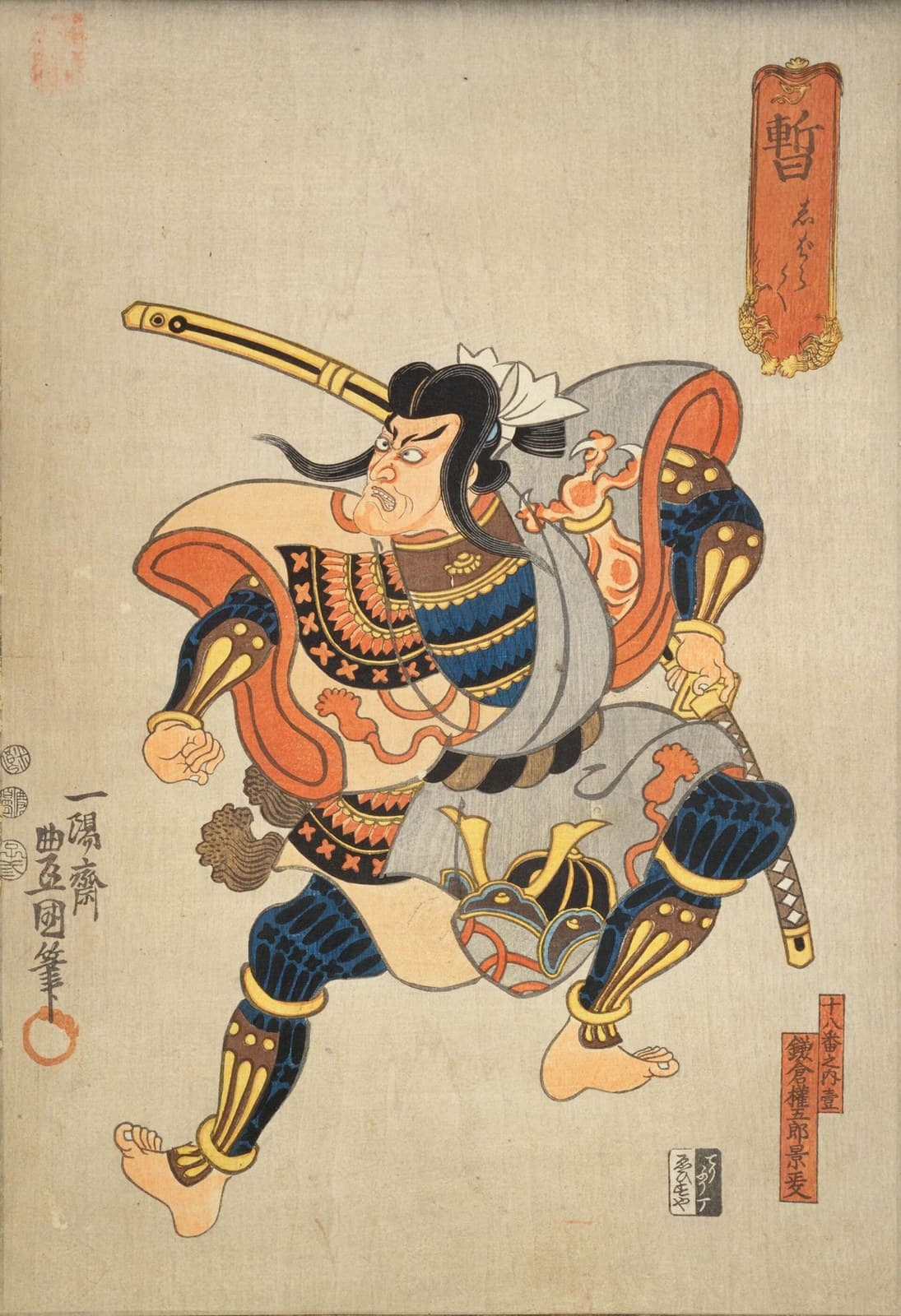
Aragoto ("wild style") is the signature acting style of Edo kabuki, said to have been created by Ichikawa Danjūrō I in the late seventeenth century. Through bold kumadori makeup, oversized costumes, thunderous delivery, and powerful mie poses, the actor becomes a superhuman hero who drives evil from the stage.
Its gentle counterpart is the wagoto style of the Kyoto–Osaka region. Aragoto is often described as more than a display of strength: it channels a god-like energy that subdues evil—clearest of all in Shibaraku or the fiery finale of Narukami.
The birth of aragoto is traced to 1673, when the teenaged Danjūrō I played the strongman Sakata no Kintoki at the Nakamura-za in Edo, his face painted in red and black as he rampaged across the stage—said to be the style's very beginning. He is believed to have drawn inspiration from kinpira jōruri, the puppet plays of superhuman warriors then wildly popular in Edo: puppet bravado reborn in a living actor's body.
Aragoto is the hereditary art of the Ichikawa Sōke (the head family of the Ichikawa Danjūrō lineage), and many of the Kabuki Jūhachiban plays belong to this style. Danjūrō XIII is its bearer in the present day.
FROM THE OFFICIAL CHANNEL
KABUKU. / Ichikawa Danjūrō.Films where this word appears
市川團十郎が語る歌舞伎の始まりと市川家の伝統
Aug 17, 2025
From kabuki's beginnings to the forceful style the first Danjūrō created — where aragoto comes from.
Plays Where You Can See It
- ShibarakuShibaraku — Just a Moment!The tyrant Kiyohara no Takehira has seized power and is about to execute a group of innocents who refuse to bow to him.Kabuki JūhachibanView play
- NarukamiNarukami — The Thunder GodThe holy priest Narukami, wronged by the imperial court, has sealed the rain-bringing dragon god beneath a waterfall, plunging the land into drought.Kabuki JūhachibanView play
- Sukeroku Yukari no Edo ZakuraSukeroku, Flower of Edo (Sukeroku Yukari no Edo Zakura)In the Yoshiwara pleasure quarter of Edo, the dashing street knight Sukeroku—lover of the great courtesan Agemaki—picks fights night after night.Kabuki JūhachibanView play
Read this next
These words meet on the same stage. Knowing one makes the next easier to see.
- 見得mieA mie is the stylized pose in which an actor freezes at a moment of peak emotion, punctuated by the sharp crack of wooden clappers.Read
- 六方roppōRoppō is a bravura stylized walk with sweeping arms and stamping feet—most famous as Benkei's "flying roppō" exit down the hanamichi in Kanjinchō.Read
- 隈取kumadoriKumadori is kabuki's distinctive makeup of bold colored lines that reveals a character's nature—red for heroic passion, blue for villainy or the supernatural.Read
- 十八番jūhachiban / ohakoThe Jūhachiban are the eighteen plays chosen by the Ichikawa Sōke as its signature repertoire—the origin of the everyday word ohako, meaning "one's speciality."Read
- 押戻しoshimodoshiOshimodoshi is the set-piece—and hero role—in which an aragoto champion pushes a raging spirit back down the hanamichi; it is also counted among the Kabuki Jūhachiban.Read
Sources & Supervision
- Author
- KABUKI Universe Editorial Team
- Supervision
- Ichikawa Danjūrō
- Published
- Aug 15, 2026
- Updated
- Sep 9, 2026
Supervision means Ichikawa Danjūrō has reviewed this page's intent and key points. The text is the editorial team's writing, not Ichikawa Danjūrō's own statements. Editorial responsibility rests with the team, which corrects any error. Read the editorial policy