kumadori
隈取
くまどりkabuki's bold makeup of colored lines
INSTANT ANSWER
Kumadori is kabuki's distinctive makeup of bold colored lines that reveals a character's nature—red for heroic passion, blue for villainy or the supernatural.
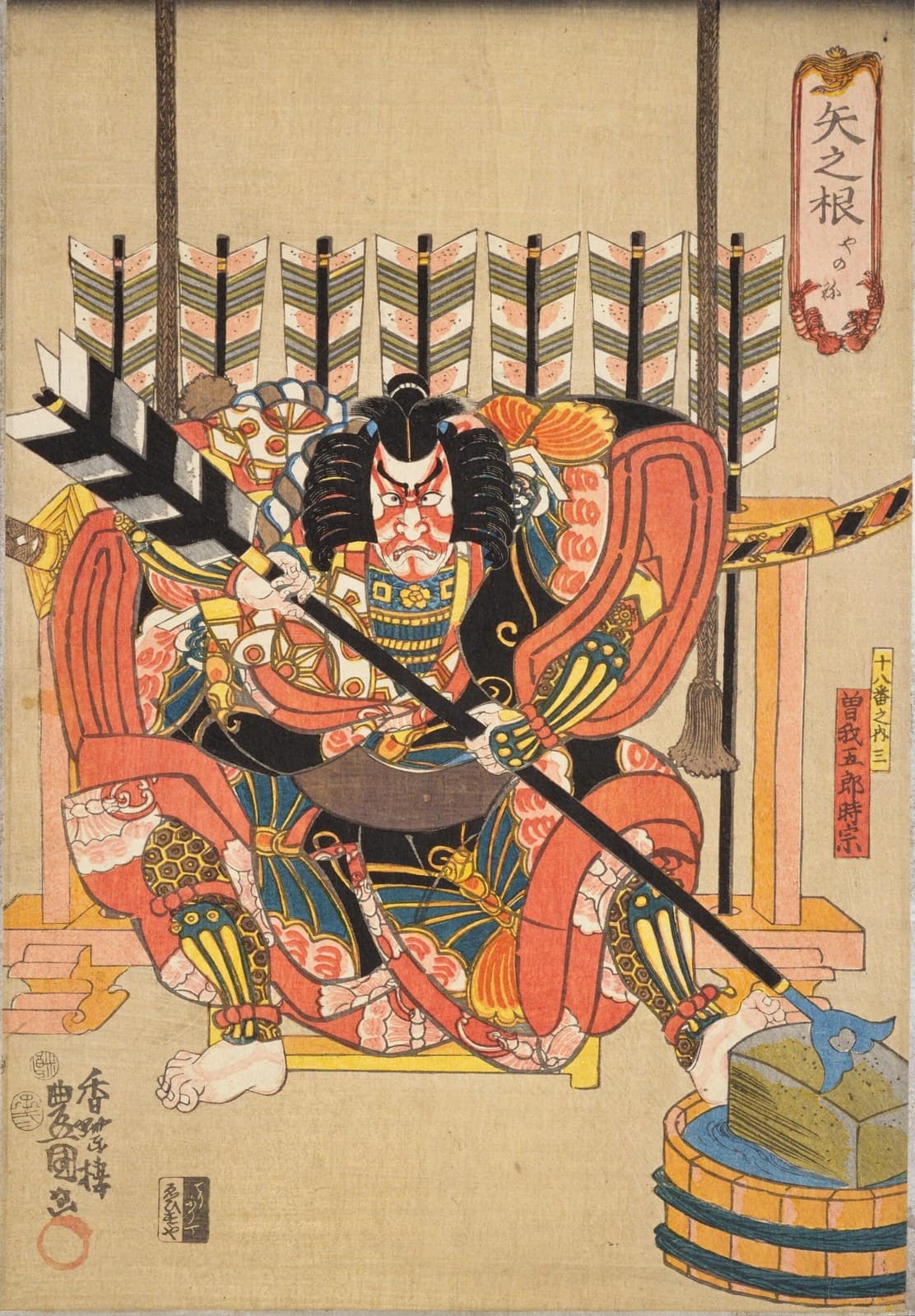
Kumadori is the art of painting a character's inner nature onto the face in colored lines, developed alongside the aragoto style. Red lines suggest justice, courage, and youthful vigor; blue signals villains and supernatural beings; brown is used for demons and spirits. The lines are said to stylize the swell of muscles and veins—sculpture drawn in makeup.
The name is said to come from the way the lines are blended ("taken") with the fingers rather than simply drawn. Each actor adjusts the kumadori to his own face, so the same role looks subtly different from actor to actor. Pressed onto cloth after a performance, the makeup becomes a one-of-a-kind imprint called oshiguma.
Nearly a hundred varieties of kumadori are said to exist, each finely matched to a type of role. The suji-guma worn by Kamakura Gongorō in Shibaraku signals superhuman strength and blazing anger; the mukimi-guma of Sukeroku's hero conveys youth, allure, and a keen sense of justice; the nihon-guma of the priest Narukami expresses composed, imposing power; and high-ranking archvillains wear the indigo kuge-are. Read the lines on a face, and a character's nature is revealed before a word is spoken.
Kumadori is said to have been begun by Ichikawa Danjūrō I together with the aragoto style, and it remains inseparable from the art of the Ichikawa Sōke. The red suji-guma of Shibaraku, its emblem, lives on in Danjūrō XIII's performances today.
Beni-guma (red)
Justice, youth, overflowing strength
Ai-guma (indigo)
Villainy, vengeful spirits, cold power
Cha-guma (brown)
Demons and creatures beyond the human
FROM THE OFFICIAL CHANNEL
KABUKU. / Ichikawa Danjūrō.Films where this word appears
【歌舞伎雑学】赤・青・茶…隈取の色の意味 #市川團十郎 #團十郎 #歌舞伎 #隈取
Jul 20, 2025
Red for loyalty and valour, blue for cruelty and madness, brown for the more-than-human — how to read a role from its colours, in about a minute.
Plays Where You Can See It
- ShibarakuShibaraku — Just a Moment!The tyrant Kiyohara no Takehira has seized power and is about to execute a group of innocents who refuse to bow to him.Kabuki JūhachibanView play
- NarukamiNarukami — The Thunder GodThe holy priest Narukami, wronged by the imperial court, has sealed the rain-bringing dragon god beneath a waterfall, plunging the land into drought.Kabuki JūhachibanView play
- Sukeroku Yukari no Edo ZakuraSukeroku, Flower of Edo (Sukeroku Yukari no Edo Zakura)In the Yoshiwara pleasure quarter of Edo, the dashing street knight Sukeroku—lover of the great courtesan Agemaki—picks fights night after night.Kabuki JūhachibanView play
Read this next
These words meet on the same stage. Knowing one makes the next easier to see.
- 荒事aragotoAragoto is the bold, larger-than-life acting style—said to have been created by Ichikawa Danjūrō I—in which heroes express superhuman power through striking makeup, oversized costumes, and dramatic poses.Read
- 押隈oshigumaAn oshiguma is a print made by pressing an actor's kumadori makeup onto silk or paper after a performance—a keepsake of that day's role.Read
- 見得mieA mie is the stylized pose in which an actor freezes at a moment of peak emotion, punctuated by the sharp crack of wooden clappers.Read
Sources & Supervision
- Author
- KABUKI Universe Editorial Team
- Supervision
- Ichikawa Danjūrō
- Published
- Aug 15, 2026
- Updated
- Sep 9, 2026
Supervision means Ichikawa Danjūrō has reviewed this page's intent and key points. The text is the editorial team's writing, not Ichikawa Danjūrō's own statements. Editorial responsibility rests with the team, which corrects any error. Read the editorial policy