From Hōreki to An'ei
The Fourth
Ichikawa Danjūrō IV
Taking up a vacant name, and finding his way in jitsuaku, not aragoto
- Life
- 1711–1778
- Bore the name Danjūrō
- 1754–1770
- Age at succession
- 44
- Earlier and literary names
- Matsumoto Shichizō (his name at his stage debut) · Matsumoto Kōshirō II (taken in 1735) · Zuinen (taken after his retirement in 1776)
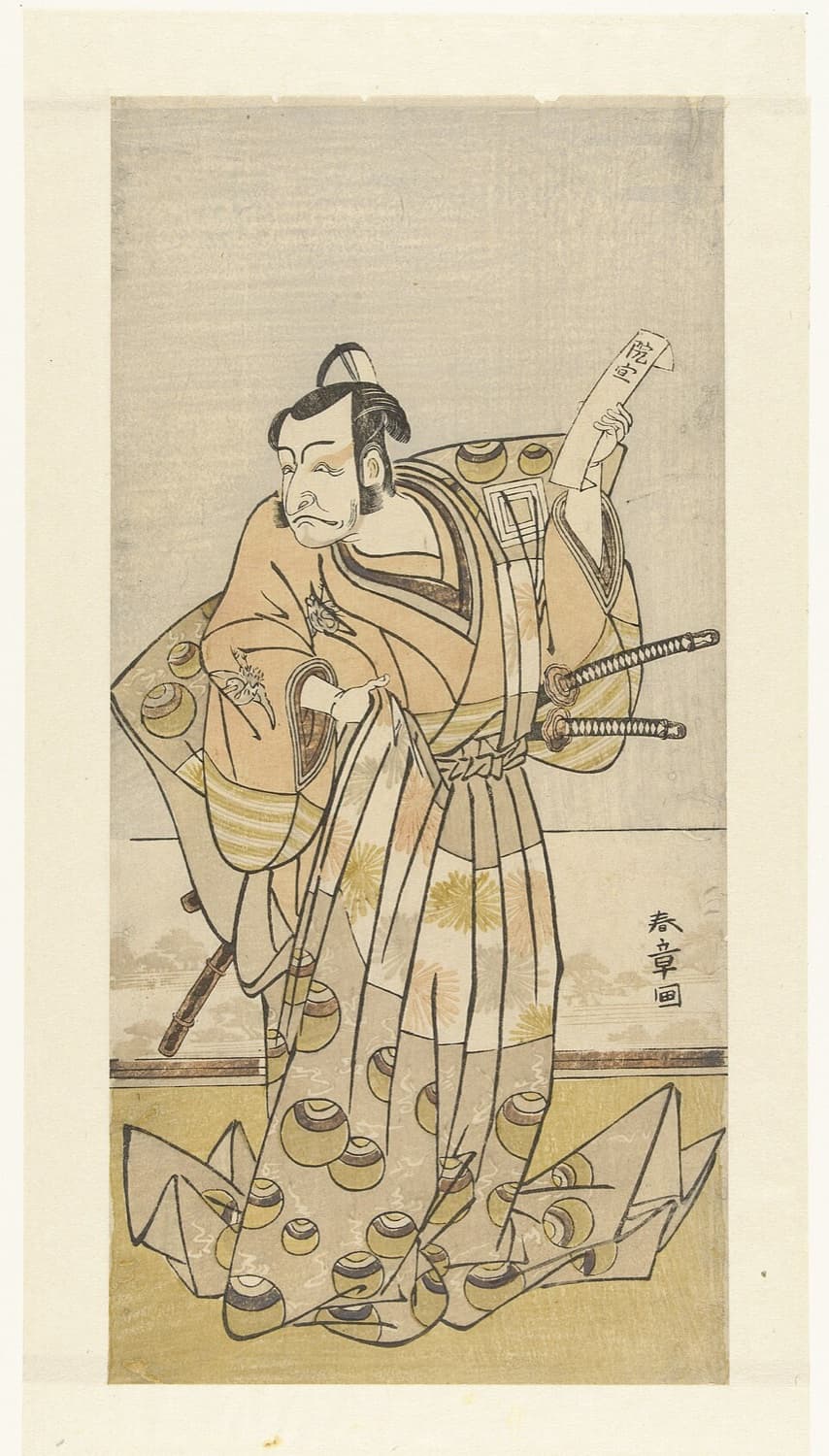
This generation in thirty seconds
Recorded as the second son of a teahouse keeper in Sakai-chō, Edo, he was also said to have been in truth the son of Danjūrō II. Adopted at three by Matsumoto Kōshirō I, he played women's roles until twenty-four. In 1754, longing for a name that had lain vacant twelve years, he was adopted by Danjūrō II and took it at forty-four. Ill-suited in build and temper to bright, open aragoto, he made his way instead through Kagekiyo plays and the jitsuaku villain.
What he inherited
A name vacant for twelve years
The Naritaya official site records that in the eleventh month of 1754, longing for the name of Danjūrō that had lain vacant for twelve years, he became the adopted son of Ebizō — Danjūrō II — and took the name as the fourth, at forty-four. The name passed not by descent but by his own wish and an act of adoption.
The Naritaya official site records him as the second son of Izumiya Kanjūrō, keeper of a large teahouse in Sakai-chō, Edo, while noting that he was also said to have been in truth the son of Danjūrō II. Its encyclopaedia likewise allows that some hold him to have been Danjūrō II's own child, while stating that he came from the Matsumoto house to the Ichikawa by adoption. Both accounts stop short of asserting either, and so does this page.
The Matsumoto art, and a start in women's roles
The Naritaya official site records that at three he was adopted by Matsumoto Kōshirō I, made his debut at nine under the name Matsumoto Shichizō, and appeared in women's roles until he was twenty-four. From the end of the Kyōhō years he turned to male leads, and in the eleventh month of 1735 became Matsumoto Kōshirō II, at twenty-five.
An aragoto he could not simply inherit
The Naritaya official site describes him as tall and long-limbed, with a narrow face lacking fullness, and hooded lids over sharp triangular eyes befitting a jitsuaku villain — features, it argues, plainly at odds with the image of Ichikawa Danjūrō built by the first and second, and unsuited to the bright, open temper of aragoto.
What he created, changed or revived
Kagekiyo plays as a way through
The Naritaya 'Danjūrō Encyclopaedia' records that, troubled by the question of his own style, he found his way through jitsugoto and villain roles, and excelled above all in the Kagekiyo plays. Meeting wife and child in prison, breaking out of the cell — through such devices, it suggests, he worked out effects a step apart from plain aragoto, and his makeup too took on the spirit of jitsuaku, adding an inked beard to the sujiguma lines.
First stagings of two of the eighteen
The Naritaya Jūhachiban pages record that he first staged Gedatsu at the Ichimuraza in the third month of 1760 and Kamahige at the Nakamuraza in the fourth month of 1774. The same source states that every play included in the eighteen was chosen from among those first staged by the first, second and fourth Danjūrō.
Shugyōkō, a working group on acting
The Naritaya official site records that he gathered disciples — Danjūrō V, Kōshirō IV, Nakamura Nakazō I among them — into a study group on acting called the Shugyōkō. Its encyclopaedia describes meetings at his house at Fukagawa Kiba given over to the study of acting and of kata, and credits him with helping others by suggestion even when he no longer performed himself.
Turning from onnagata to male leads
He appeared in women's roles until twenty-four and turned to male leads at the end of the Kyōhō years, the Naritaya official site records. That he had passed through the onnagata art before entering a house of aragoto is not to be overlooked in weighing the range of his playing.
Signature roles and plays
The Naritaya official site gives the première as the third month of 1760 at the Ichimuraza. The plot, it says, seems to have had the ghost of Akushichibyōe Kagekiyo appear in a girl's form, dance out resentment and delusion, then attain release and vanish in Kagekiyo's own shape.
Kamahige (Oatsuraezome Soga no Hinagata)
The Naritaya official site gives the première as the fourth month of 1774 at the Nakamuraza. A smith, Shirōbei — in truth Mihonoya no Shirō — tries under cover of a shave to take off the head of Kagekiyo, disguised as an itinerant ascetic, but Kagekiyo cannot be cut. The staging came after he had passed the name to the fifth.
Kagekiyo, and the Kagekiyo plays
Kagekiyo itself was first staged by Danjūrō II at the Nakamuraza in 1732, but the Naritaya 'Danjūrō Encyclopaedia' records that it was the fourth who excelled in the Kagekiyo plays above all, and that the role came to be treated thereafter as an important one for the Ichikawa house.
Sugawara Denju Tenarai Kagami — Matsuōmaru
The Naritaya 'Danjūrō Encyclopaedia' records that in 1776, on the closing day of a run in which he played Matsuōmaru in Sugawara Denju Tenarai Kagami — a speciality of his — for the last time in his life, he shaved his head, renamed himself Zuinen and retired, to the astonishment of his household.
Kabuki in his age
By the middle of the eighteenth century puppet theatre had reached its height, and its hits were carried into kabuki one after another. The Japan Arts Council records that Sugawara Denju Tenarai Kagami, Yoshitsune Senbon Zakura and Kanadehon Chūshingura were revived again and again, until they were called the three masterpieces of the gidayū repertoire. In dance, the shosagoto accompanied by nagauta developed, and in 1753 Nakamura Tomijūrō I first staged Kyōganoko Musume Dōjōji. The Edo theatre year opened with the kaomise of the eleventh month, and the 'wait a moment' scene played there over and over grew steadily more refined until its staging settled into the piece later known as Shibaraku.
Meanwhile, in the world
- —Art & plays
Three gidayū masterpieces enter kabuki
The Japan Arts Council records that as puppet theatre reached its height in the mid-eighteenth century, its hits were moved into kabuki one after another — Sugawara Denju Tenarai Kagami, Yoshitsune Senbon Zakura and Kanadehon Chūshingura above all, revived so often that they came to be called the three masterpieces of the gidayū repertoire. They still make up a large share of the kabuki repertoire today.
- 1753Art & plays
The première of Kyōganoko Musume Dōjōji
The Japan Arts Council explains that the Dōjōji plays, staged since the Genroku years, were gathered to their summation in Kyōganoko Musume Dōjōji, first performed by Nakamura Tomijūrō I in 1753 — a great work of onnagata dance carried by a single performer for close to an hour. It came the year before his own succession.
- —Art & plays
The staging of Shibaraku settles at the kaomise
The Japan Arts Council explains that it was customary to build into the varied plays of the kaomise a scene in which a figure of blazing justice enters on the cry of 'shibaraku' and saves people about to be killed by a villain; played again and again, the scene grew more refined until its staging was fixed. Only from the Meiji era was it performed as the separate piece Shibaraku.
Where the age and the actor meet
- 1735Art & plays
Taking the Kōshirō name at the run where Danjūrō moved
The Naritaya official site records that at the run of the eleventh month of 1735, at which Danjūrō II became Ebizō and Masugorō became Danjūrō III, Matsumoto Shichizō also took the name Matsumoto Kōshirō II, at twenty-five. It coincided with his turn from women's roles to male leads, and the road that would carry him to the Danjūrō name began there.
- 1754Art & plays
Taking the vacant name by adoption
The Naritaya official site records that in the eleventh month of 1754, longing for a name vacant twelve years, he became the adopted son of Ebizō — Danjūrō II — and took the name as the fourth, at forty-four. Seen from the other side, Danjūrō II, having lost his third, took in a forty-four-year-old son at sixty-seven.
- 1770Art & plays
Passing the name to his son, and going back to the old one
The Naritaya official site records that in 1770, at sixty, he had his own son, Matsumoto Kōshirō III, take the name Danjūrō V, while he himself returned for a time to his former name of Kōshirō. He went on performing after handing the name over, first staging Kamahige in 1774.
- 1776Society
Shaving his head, and the boss of Kiba
The Naritaya official site records that in 1776, at sixty-six, he abruptly shaved his head on the closing day of a run at the Ichimuraza and retired, taking the name Zuinen, withdrawing to his house at Fukagawa Kiba and keeping company with chivalrous commoners and fellow haikai poets. Its encyclopaedia relates that his obliging nature and his retreat to Kiba earned him the affectionate name of the boss of Kiba.
From this generation to the next
Carrying a body and temper unsuited to aragoto, he built his art instead in jitsuaku and the Kagekiyo plays. The Naritaya official site records that he became an actor who did no dishonour to the name of Ichikawa Danjūrō, and that he carried the current of the Ichikawa line through to his son, the fifth. In retirement he held the Shugyōkō at Fukagawa Kiba, handing on kata after he had stopped performing.
Where the sources differ
On the following points the sources we consulted disagree. Rather than declare one correct, we set them side by side and state how we have handled each.
Where the fourth generation came from
He is recorded as the second son of Izumiya Kanjūrō, who kept a large teahouse in Sakaichō, Edo.
Source: 成田屋(市川團十郎家)公式サイト「家系図 四代 市川團十郎」
There is also an account that he was in fact a natural son of Danjūrō II.
How we handle it
Both sources give this as something said rather than something established. Our text carries both accounts and asserts no descent either way. What both agree on is that he took the name by adoption in 1754.
How the farewell performance of 1776 is described
He retired on the closing day of a run at the Ichimuraza — the account names the theatre.
Source: 成田屋(市川團十郎家)公式サイト「家系図 四代 市川團十郎」
He retired on the closing day on which he played Matsuōmaru in Sugawara Denju Tenarai Kagami for the last time — the account names the play.
How we handle it
The year is the same in both, but neither source states whether the theatre and the play belong to the same day. Our text keeps them apart rather than joining them into a single occasion.
What remains today
The roles in which he excelled came to be treated as important ones for the Ichikawa house, the Naritaya official site records. Kagekiyo is one of the Kabuki Jūhachiban.
The jitsuaku role
The villain who goes all the way into evil. The direction in which he found his way was carried on by later generations.
The Shugyōkō he held at Fukagawa Kiba was a gathering in which actors studied acting and kata together. As a student, Danjūrō XII chose the Shugyōkō and its influence on Danjūrō V as the subject of his graduation thesis.