From An'ei and Tenmei into Kansei
The Fifth
Ichikawa Danjūrō V
The actor who could play anything, and widened what a Danjūrō could be
- Life
- 1741–1806
- Bore the name Danjūrō
- 1770–1791
- Age at succession
- 30
- Earlier and literary names
- Matsumoto Kōzō (his name at his stage debut) · Matsumoto Kōshirō III · Ichikawa Ebizō, written with the 鰕 character (taken in 1791) · Naritaya Shichizaemon (the name he used in retirement) · Hakuen (haimyō, his poetry name)
This generation in thirty seconds
A son of Danjūrō IV. When his father took the name Danjūrō IV he succeeded to Matsumoto Kōshirō III, and in the eleventh month of 1770, at thirty, became Danjūrō V. Beyond aragoto he extended his range into jitsugoto, pure onnagata roles, comic parts and chivalrous commoners — an actor who, as the phrase went, could turn his hand to anything. The Naritaya official site relates that his poetry name Hakuen carried a deliberate humility: he was, he said, no match for the masters among his forebears.
What he inherited
From the Matsumoto house to the Ichikawa
He made his debut in the first month of 1754 at fourteen, as Matsumoto Kōzō. In the eleventh month of that year his father, Matsumoto Kōshirō, took the name Danjūrō IV, and he succeeded to the vacated name as Kōshirō III, the Naritaya official site records. He grew up as the Ichikawa and Matsumoto names passed back and forth.
The shugyōkō study group
The Naritaya official site describes the shugyōkō, a study group at which Danjūrō IV gathered his son — the future Danjūrō V — and Kōshirō IV among others at his Fukagawa Kiba home to work on acting and kata. Danjūrō IV is credited with helping through suggestion to his pupils, even where he did not perform himself.
Jitsuaku, and the Kagekiyo plays
The Naritaya official site records that he closely resembled his father in face and build, and in manner of acting too: in his Kōshirō years he was recognised for jitsuaku roles such as Kagekiyo. His father had made the Kagekiyo plays a speciality, and the role later came to be treated as an important one for the Ichikawa house.
What he created, changed or revived
An actor who could turn his hand to anything
After taking the name, the Naritaya official site records, he deliberately applied himself to jitsugoto, took on pure onnagata roles that no previous Danjūrō had played, and extended his range into comic and chivalrous-commoner parts. The family-tree page heads this generation simply as the actor who could do it all.
The first Danjūrō to play Yuranosuke
He was the first Danjūrō to play Yuranosuke in Kanadehon Chūshingura, the Naritaya official site records — the head of an aragoto house taking a central role in one of the great gidayū plays.
Playing many roles with the new quick-change
The Naritaya official site notes that he could play many parts himself using hayagawari, the quick-change then newly appearing as a staging method — a new technique put at once to the service of his breadth.
The Naritaya official site relates that Hakuen was first used by him — homophonous with names borne by the second and fourth of the line, but written so as to style himself a monkey 'three hairs short' of the mastery of his forebears, a joke he also made from the stage in kōjō. He is said to have given his own verse and essays titles such as 'the friendless monkey'.
Kōjō as an art of speech
The Naritaya official site insists that the Ichikawa house, for all its reputation in the muscular art of aragoto, was also a house of eloquence — and recounts that the kōjō he delivered when his son took the name Danjūrō VI and he himself became Ebizō was so celebrated that audiences came for the speech itself.
Signature roles and plays
Kanadehon Chūshingura — Ōboshi Yuranosuke
The Naritaya official site records this as the first time a Danjūrō took the role. The year of that performance has not been confirmed.
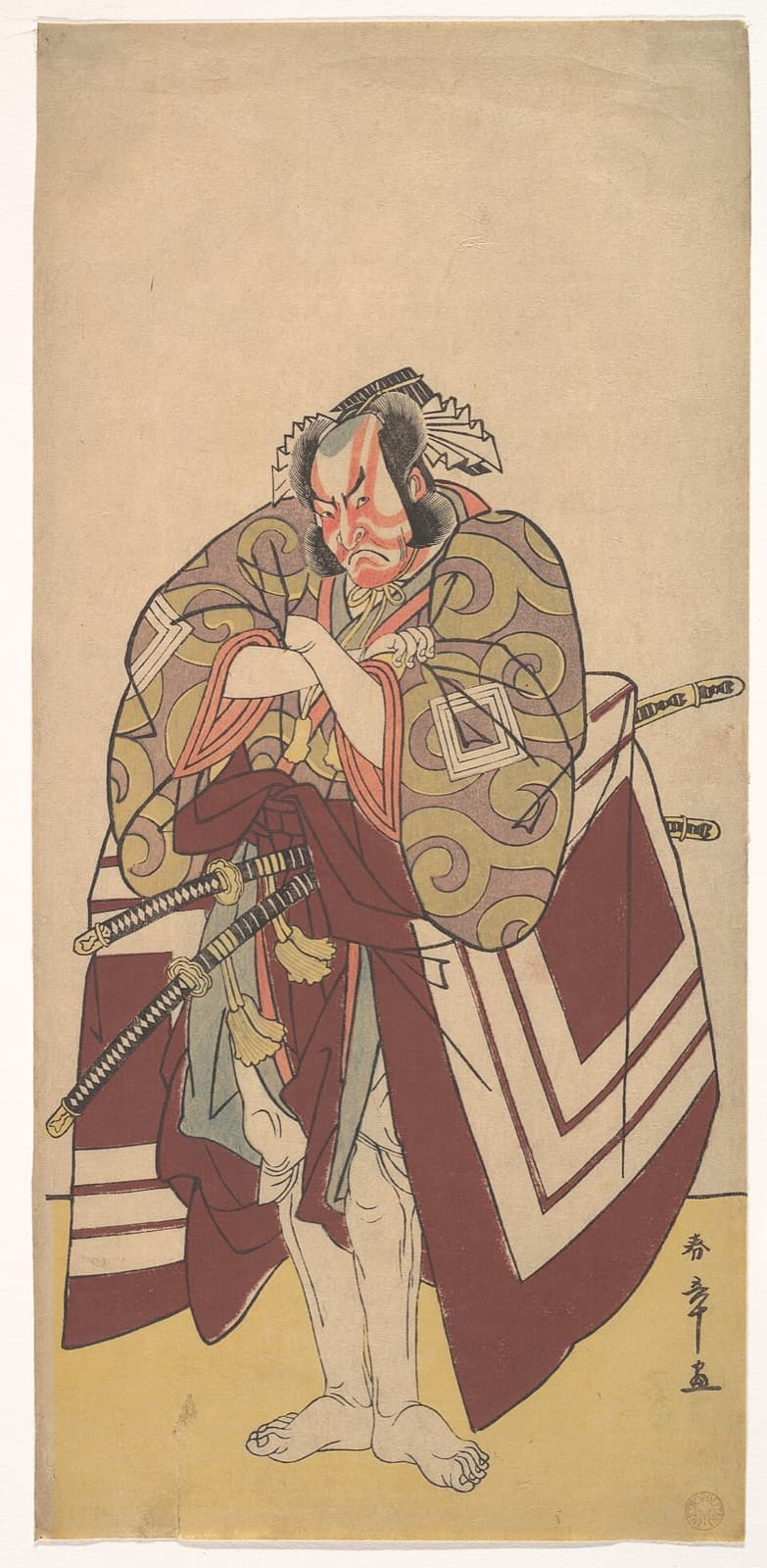
The Naritaya official site describes a print by Katsukawa Shunkō in which he stands, still in his Shibaraku costume, between the sumo champion Tanikaze and the Yoshiwara courtesan Kasen, holding a referee's fan.
The Kagekiyo plays
The jitsuaku line of roles in which he excelled during his Kōshirō years. The Naritaya official site explains that Aku Shichibyōe Kagekiyo, the Taira warrior who hates the Genji, meets his wife and child in prison and breaks out of gaol — effects of a different order from plain aragoto.
A farewell run at the Miyakoza, eleventh month of 1796
Often ill in his later years, he gave a farewell run at the Miyakoza and retired, at fifty-six, the Naritaya official site records. Its entry on his retirement hermitage relates that around this time he told the audience how it felt, at an age when most men would have retired, still to be sitting at the mirror applying white makeup.
Kabuki in his age
The Naritaya official site describes the An'ei, Tenmei and Kansei years of his career as the season in which Edo kabuki came fully into flower, and in which an actor was judged above all on the strength of his acting. By then, the Japan Arts Council records, the hits of the puppet theatre had been carried across one after another until gidayū plays made up a large share of the repertoire, while jōruri styles such as tokiwazu and tomimoto entered the accompaniment and produced dance pieces with a strongly dramatic cast. New staging methods, the quick-change among them, were appearing too.
Meanwhile, in the world
- 1772–1801Art & plays
Edo kabuki comes into flower
Of the years from An'ei (1772–81) and Tenmei (1781–89) into Kansei (1789–1801), the Naritaya official site writes that Edo kabuki was in full flower, and that it was an age in which an actor's ability as a performer was highly prized.
- —Art & plays
Gidayū plays take over much of the repertoire
The Japan Arts Council records that as the puppet theatre reached its height in the mid-eighteenth century, its hits were carried across into kabuki one after another. Sugawara Denju Tenarai Kagami, Yoshitsune Senbon Zakura and Kanadehon Chūshingura were revived again and again, until they were spoken of as the three masterpieces of the gidayū repertoire.
- —Art & plays
Dance pieces develop, with jōruri accompaniment
The Japan Arts Council records that jōruri styles such as tokiwazu and tomimoto were taken into kabuki's accompaniment; because these were narrative arts by origin, the dance pieces built on them carried strong dramatic weight. Such pieces came to be performed by tachiyaku as well as onnagata, and Tsumoru Koi Yuki no Sekinoto was first staged in the latter half of the eighteenth century.
Where the age and the actor meet
- —Society
Counted among the three faces of Edo
The Naritaya official site records that some two hundred years ago the phrase 'the three faces of Edo' spread through the streets, naming as the popular stars of the day Danjūrō V, the sumo champion Tanikaze and the Yoshiwara courtesan Kasen — the theatre, the wrestling ring and the pleasure quarter, each with its representative figure.
- —Media
His friendship with the writer Utei Enba
The Naritaya official site records that he was sworn as a brother to Utei Enba, known as the compiler of the Kabuki Nendaiki. Its dictionary adds that Enba's house in Honjo Aioichō carried the mimasu crest on everything from roof to furniture, that he styled himself Danshūrō in echo of the actor's name, and that the two wrote comic fiction together.
- 1791Art & plays
Handing on the name, and becoming Ebizō
In the eleventh month of 1791, at fifty-one, he had his son take the name Danjūrō VI and renamed himself Ebizō — but written with a character meaning a small fry rather than the fine lobster of the usual spelling. The Naritaya official site explains the humility in it, and quotes his kōjō: his elders were masters, the ornamental lobsters of Edo; he was small fry.
- 1796–1806Society
Retirement at the Hogoan, and a death mid-verse
After retiring in the eleventh month of 1796 he withdrew to the Hogoan at Honjo Ushijima, took the name Naritaya Shichizaemon, and entered a life of elegant retreat among men of letters, the Naritaya official site records. He died on 30 October 1806, at sixty-six, in the middle of a verse gathering that had begun the day before.
From this generation to the next
He left behind a Danjūrō who was not aragoto alone but an actor of every register. Having passed the name to his son, he became Ebizō and withdrew into the company of writers. His poetry name Hakuen was taken up by Danjūrō VII, and the thirteenth of the line has carried it into the stage name itself.
Where the sources differ
On the following points the sources we consulted disagree. Rather than declare one correct, we set them side by side and state how we have handled each.
Which generation the persimmon colour, danjūrō-cha, belongs to
It was Danjūrō II who used persimmon for the hero's robe in Shibaraku, and from then on it became the colour of aragoto and of the Ichikawa house.
The colour swept Edo after Danjūrō V wore a persimmon robe in Shibaraku, and it came to bear his name as danjūrō-cha.
Source: コトバンク「団十郎茶」
How we handle it
Fixing a colour as the colour of aragoto and lending one's name to a street fashion are two different things, and the two accounts may well both be true. Lacking corroboration, our text for the fifth generation says nothing of the colour; the glossary entry carries both accounts. The word danjūrō-cha itself does not appear on the official Naritaya site.
What remains today
First used by Danjūrō V and taken up by Danjūrō VII; the thirteenth bears it in his stage name, as Ichikawa Danjūrō Hakuen.
Breadth as a measure of an actor
The ability to move between aragoto, jitsugoto, onnagata and comic roles became one of the measures by which later Danjūrō were judged.
Danjūrō V in the actor prints
The Naritaya official site identifies him as the model for Sharaku's Takemura Sadanoshin, drawn after he had passed the name to his son and become Ebizō. The image was later issued as a ten-yen postage stamp in 1956.