Kansei
The Sixth
Ichikawa Danjūrō VI
The broken sword of the mimasu crest — a generation ended at twenty-two
- Life
- 1778–1799
- Bore the name Danjūrō
- 1791–1799
- Age at succession
- 14
- Earlier and literary names
- Tokuzō (his name at his stage debut) · Ichikawa Ebizō IV
This generation in thirty seconds
Born a son of Danjūrō V, he passed through the households of a disciple and a relative before being formally adopted by his father. In the eleventh month of 1791, at fourteen, he became Danjūrō VI. He is remembered as a young actor of real bloom and beauty. In the third month of 1799 he played Sukeroku, an art of his house, for the first time and scored a great hit; the following month he withdrew from the bill, and died at twenty-two, leaving a verse behind him.
What he inherited
Adopted by way of a disciple's and a relative's house
The Naritaya official site records that although he was a son of Danjūrō V, he was taken in by the disciple Ichikawa Masuzō, then adopted for a time by Izumiya Kanjūrō — a theatre-teahouse keeper and a cousin of Danjūrō V — before being formally adopted by his father at the age of four. The name did not move by blood alone; it travelled through the households of disciples and relatives.
The Naritaya official site records that in the eleventh month of the year of his debut he took the name Ebizō IV at the Nakamuraza. Ebizō traces back to the childhood name of Danjūrō I and is held to be, after Danjūrō itself, the weightiest name in the house.
In the third month of 1799 he played Sukeroku, an art of his house, for the first time and scored a great hit, the Naritaya official site records. The play would later be among the eighteen chosen by Danjūrō VII.
What he created, changed or revived
A Danjūrō in his bloom
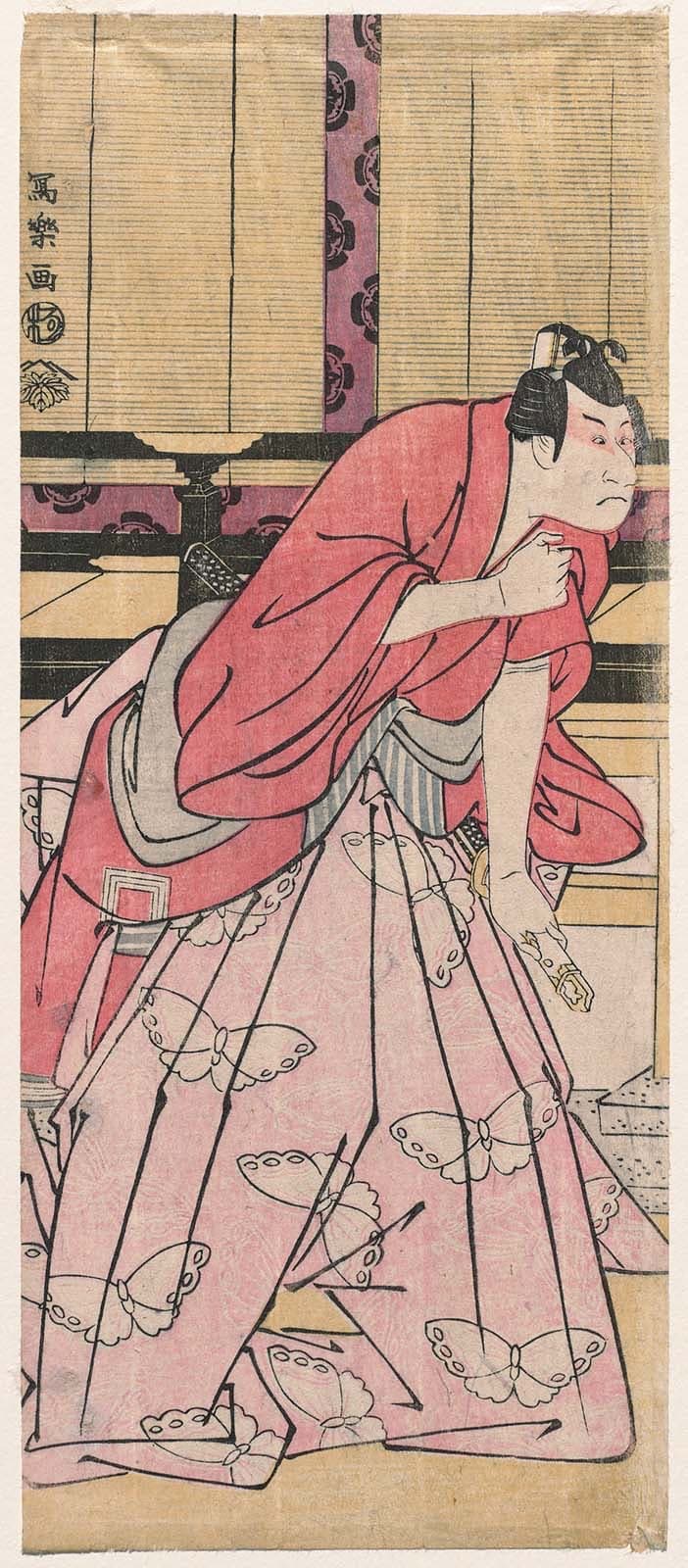
The Naritaya official site relates that he seems to have been a handsome young actor in full bloom, and that girls are said to have waited for him at the stage door. From the likeness prints, it adds, one may imagine a high, straight-bridged nose and distinctive eyebrows, with the same engaging look his father had. The site hedges throughout, and this entry keeps to the same footing.
The weight carried at nineteen
With the retirement of Danjūrō V in 1796, the Naritaya official site records, expectations of the nineteen-year-old Danjūrō grew heavier still, and so did his responsibilities. His father's withdrawal left a young head of the house carrying it alone.
Signature roles and plays
Nanakusa Yosooi Soga — Zatō Tokunoichi
Nakamuraza, first month of Tenmei 3. The Naritaya official site records this as his debut, at five, under the name Tokuzō. See the review notes on the Western-calendar equivalence.
Third month of 1799: his first attempt at an art of his own house, and a great hit. It proved to be his last.
Kabuki in his age
The Kansei years in which he bore the name fall at the close of what the Naritaya official site calls the flowering of Edo kabuki. By then, the Japan Arts Council records, dance pieces accompanied by tokiwazu and tomimoto had matured and were danced by tachiyaku as well as onnagata. Actor prints were pouring from the publishers: the Naritaya site notes that his father, retired and calling himself Ebizō, was among those drawn by Sharaku. Popularity on stage had become, directly, a product on the shelf.
Meanwhile, in the world
- 1789–1801Art & plays
The last of Edo kabuki's flowering
The Naritaya official site describes the span from An'ei and Tenmei into Kansei (1789–1801) as the full flowering of Edo kabuki, an age in which an actor was judged on the strength of his acting. The eight years in which he bore the name fall at the end of it.
- —Media
Actor prints, and Sharaku
The Naritaya official site identifies the model for Sharaku's Takemura Sadanoshin as Danjūrō V, after he had passed the name to his son and become Ebizō. The years in which the sixth bore the name were the years in which actor prints were a major commodity for Edo's publishers.
- —Art & plays
Dance pieces reach the tachiyaku
The Japan Arts Council records that jōruri styles such as tokiwazu and tomimoto entered the accompaniment, producing dance pieces of strong dramatic weight, and that such pieces came to be performed by tachiyaku as well as onnagata.
Where the age and the actor meet
- 1791Art & plays
Taking the name at the Ichimuraza kaomise
In the eleventh month of 1791, at fourteen, he took the name Danjūrō VI at the Ichimuraza kaomise. On the same occasion his father became Ebizō, and the Naritaya official site records that the kōjō delivered then was so celebrated that audiences came for it.
- 1796Art & plays
His father's retirement, and a young head of house
The Naritaya official site records that when Danjūrō V retired in 1796, expectations of the nineteen-year-old Danjūrō grew heavier still, and his responsibilities with them.
- 1799–1799Art & plays
From the triumph of Sukeroku to a death two months later
The Naritaya official site records that in the third month of 1799 he played Sukeroku, an art of his house, for the first time and scored a great hit; that the following month a cold kept him from the bill; and that he never returned, leaving the verse 'how can this be — the iris-blade of the mimasu crest, broken'. He died on the thirteenth day of the fifth month of that year, at twenty-two.
From this generation to the next
His sudden death at twenty-two sent the name straight on to the next generation: in the eleventh month of 1800 a ten-year-old was abruptly made Danjūrō VII at the Ichimuraza kaomise. The single year in which he took up Sukeroku and triumphed in it is, brief as it was, what keeps his name.
Where the sources differ
On the following points the sources we consulted disagree. Rather than declare one correct, we set them side by side and state how we have handled each.
The years of his adoption and stage debut — the era names and the Western years do not agree
By the era names — adopted anew by Danjūrō V in Tenmei 2 at the age of four, first stage appearance in the first month of Tenmei 3 at five — the years are 1782 and 1783.
Source: 成田屋(市川團十郎家)公式サイト「家系図 六代 市川團十郎」
The Western years printed alongside on the same page are 1781 and 1782 — and it is these that agree with the ages counted from his birth year of 1778.
Source: 成田屋(市川團十郎家)公式サイト「家系図 六代 市川團十郎」
How we handle it
Within a single page the era names and the Western years stand one year apart, and we cannot tell which is right. Our text therefore gives only the era names for these two events, without Western years, and the debut year is kept out of the timeline altogether.
What remains today
'The broken iris-blade of the mimasu crest'
The verse said to have been left during his withdrawal from the bill. The Naritaya family-tree page uses it as the heading for this generation. Mimasu is the crest of the Ichikawa house.
A name that does not move by blood alone
His path — through a disciple's household and a relative's theatre teahouse before adoption — is one illustration of how the Ichikawa name has been handed on among adopted sons, disciples and kin.