From Kyōhō to Kanpō
The Third
Ichikawa Danjūrō III
The name at fifteen, gone at twenty-two — and an interval begins
- Life
- 1721–1742
- Bore the name Danjūrō
- 1735–1742
- Age at succession
- 15
- Earlier and literary names
- Ichikawa Masugorō (his name at his stage debut)
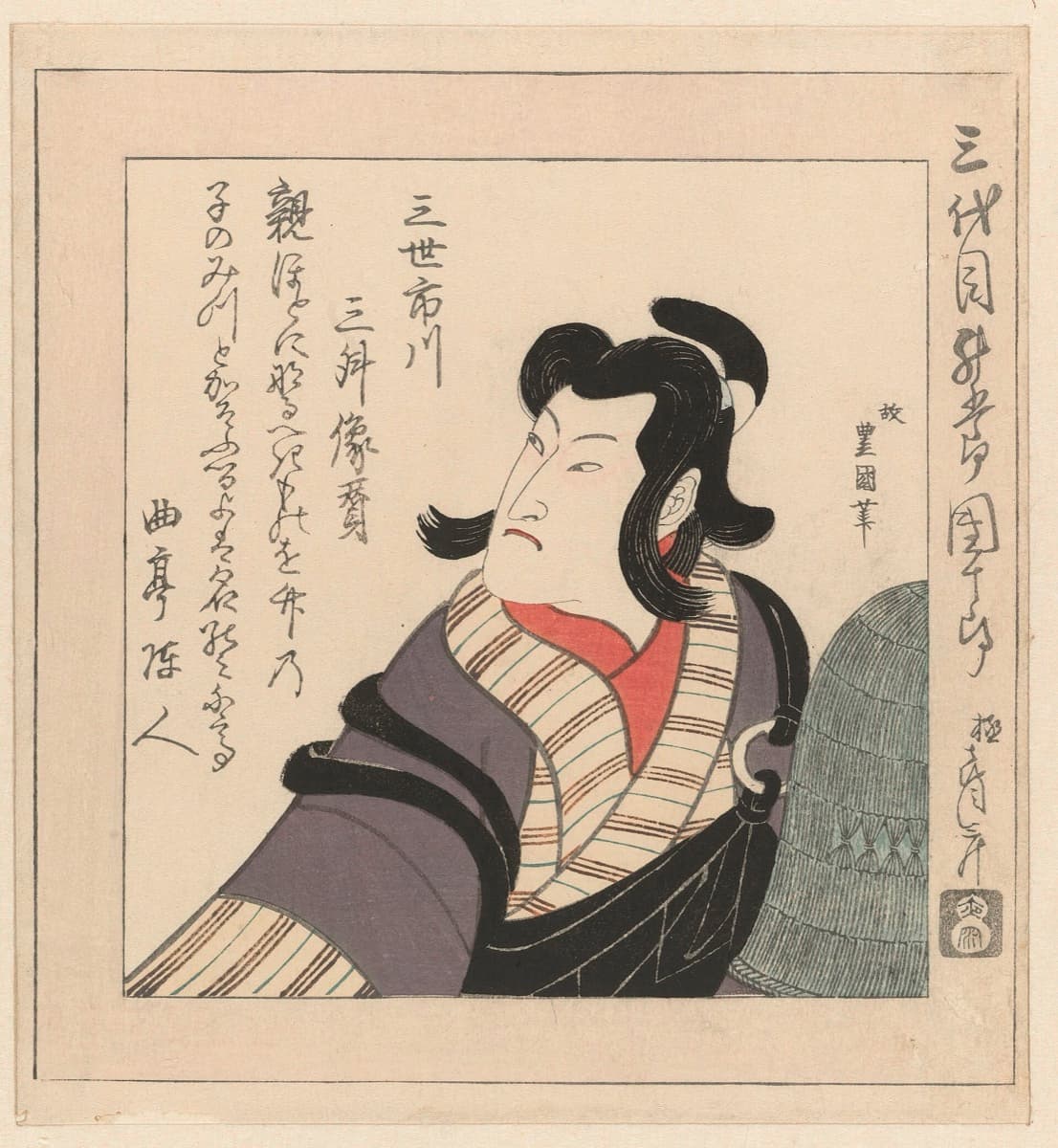
This generation in thirty seconds
Born to Mimasuya Sukejūrō, a senior disciple of Danjūrō I, he was adopted by Danjūrō II at five. In the eleventh month of 1735 he took the name at fifteen, at the Ichimuraza kaomise, on the same bill on which his foster father became Ebizō II. In 1742, having fallen ill on a journey to Osaka and returned to Edo, he died at twenty-two — and the name of Danjūrō went unused for more than a decade.
What he inherited
The Naritaya official site records that he was born in 1721, the son of Mimasuya Sukejūrō, a senior disciple of Danjūrō I, and was adopted by Danjūrō II in 1725, at five. The name passed not by blood but by adoption out of a disciple's household.
Taking the name at the kaomise
In 1727 he made his debut at seven, at the Nakamuraza kaomise, under the name Ichikawa Masugorō; in the eleventh month of 1735 he took the name Ichikawa Danjūrō III at the Ichimuraza kaomise, at fifteen. The Japan Arts Council explains that in Edo kabuki actors contracted with a playhouse for a year at a time, and the kaomise of the eleventh month — where the troupe's faces were shown — was the most important event of the year.
Aragoto as the art of the house
He stood to inherit aragoto — begun by Danjūrō I and held to have been perfected by Danjūrō II — while his foster father was still living. The Naritaya official site describes how Danjūrō II founded Sukeroku, Yanone and Kenuki, and so established the art of the house.
What he created, changed or revived
Twenty-two years, little recorded
The Naritaya official site records that, for all the future expected of him as heir, he died at twenty-two and never came into his full stature as an actor. Nothing that this generation newly founded — no technique, no staging — appears in the public sources consulted here, and nothing is supplied by conjecture.
The Naritaya official site records that his unexpected and far too early death left the name of Ichikawa Danjūrō vacant for more than ten years. This generation shows, by its outcome, that succession is no automatic chain.
Signature roles and plays
A debut at the Nakamuraza kaomise
In 1727, at seven, he first appeared under the name Ichikawa Masugorō. The Naritaya official site does not name the play.
The succession at the Ichimuraza kaomise
In the eleventh month of 1735 he became Ichikawa Danjūrō III, at fifteen. On the same bill his foster father became Ebizō II, and Matsumoto Shichizō became Matsumoto Kōshirō II.
The journey to Osaka, and the return
In 1741, the Naritaya official site records, he travelled to Osaka with his foster father Ebizō but fell ill almost at once and returned to Edo, at twenty-one.
Kabuki in his age
The Japan Arts Council explains that the Edo kabuki year opened with the kaomise of the eleventh month, and that actors contracted with a playhouse a year at a time. Both his debut and his succession took place at such a kaomise. In the same years, following the current begun by Chikamatsu, puppet-theatre plays were carried one after another into kabuki, and the body of work called gidayū kyōgen was taking shape. In dance too, the shosagoto accompanied by nagauta was first forming as an art of the onnagata. Since 1714 the licensed large theatres had numbered three: the Nakamuraza, the Ichimuraza and the Moritaza.
Meanwhile, in the world
- —Art & plays
The kaomise, an annual institution
The Japan Arts Council explains that in Edo kabuki actors signed with a playhouse for a year, and that the run of the eleventh month, when those contracts began, was called the kaomise — the year's most important occasion, at which the troupe's line-up was presented. Shibaraku itself grew out of the customs of that event.
- —Art & plays
Puppet plays continue crossing into kabuki
The Japan Arts Council records that many of Chikamatsu Monzaemon's works were carried into kabuki and became important pieces there, leading the way for the practice as a whole. By the middle of the eighteenth century, when puppet theatre reached its height, its hits would be moved across one after another.
- —Art & plays
Shosagoto takes shape as an onnagata art
The Japan Arts Council records that kabuki's dance side, present from its beginnings, advanced with the vogue for song and shamisen, and that the dance plays called shosagoto or furigoto took shape — accompanied by nagauta, and at first as an art of the onnagata.
Where the age and the actor meet
- 1735Art & plays
Three names move at a single kaomise
The Naritaya official site records that at the run of the eleventh month of 1735, Danjūrō II became Ebizō, Masugorō became Danjūrō III, and Matsumoto Shichizō became Matsumoto Kōshirō II. It was this Shichizō who, after a twelve-year interval, would become Danjūrō IV.
- 1741Art & plays
To Kamigata with his foster father
In 1741, the Naritaya official site records, he travelled to Osaka with his foster father Ebizō but fell ill at once and returned to Edo. Ebizō premièred Kumedera Danjō in Kenuki there and won recognition for his jitsugoto in the Kamigata region — and it was during that stay that word reached him of his son's death. It is one ending to an age in which actors moved between Kamigata and Edo.
From this generation to the next
He died on 27 February 1742, at twenty-two. His foster father Ebizō offered a verse in mourning. For more than ten years afterwards the name of Danjūrō went unused, and was not taken again until 1754, when Matsumoto Kōshirō II was adopted into the house and raised as the fourth.
Where the sources differ
On the following points the sources we consulted disagree. Rather than declare one correct, we set them side by side and state how we have handled each.
How long the name Danjūrō lay vacant after his death
The page for the third generation says the name lay vacant for more than ten years.
Source: 成田屋(市川團十郎家)公式サイト「家系図 三代 市川團十郎」
The page for the fourth generation says it lay vacant for twelve years.
Source: 成田屋(市川團十郎家)公式サイト「家系図 四代 市川團十郎」
How we handle it
The same official source phrases the interval in two ways. Our text keeps each source's own wording rather than levelling them into one figure. Either way, the name stood vacant between his death in 1742 and the fourth succession in 1754.
What remains today
That succession is not automatic
After his death the name lay vacant for more than ten years. Ichikawa Danjūrō has never been handed on automatically, in order of blood.
He himself came into the house by adoption from a disciple's family, and the fourth was likewise taken in as a son.