From late Genroku into Kyōhō
The Second
Ichikawa Danjūrō II
Softening aragoto with wagoto, and fixing the family art
- Life
- 1688–1758
- Bore the name Danjūrō
- 1704–1735
- Age at succession
- 17
- Earlier and literary names
- Ichikawa Ebizō II (taken in 1735)
This generation in thirty seconds
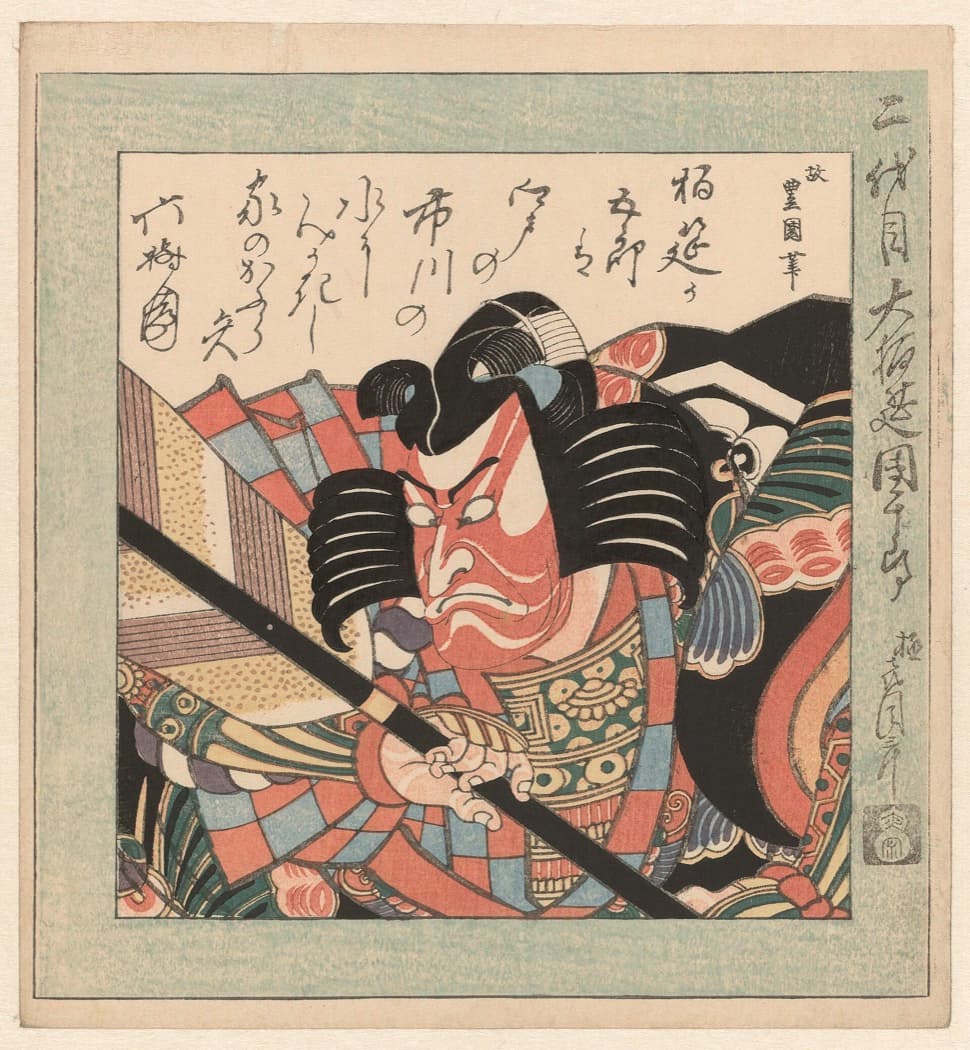
The sudden death of his father brought him the name in 1704, at seventeen. Backed and taught by Ikushima Shingorō, a master of Edo wagoto, he built a new manner of playing that laid the softness of wagoto and jitsugoto over the frame of aragoto. He first staged Sukeroku, Yanone and Uirō Uri among others, and brought the kumadori makeup to its settled form — assembling the body of work later known as the Kabuki Jūhachiban.
What he inherited
Called the child granted by Fudō
The Naritaya official site records a rumour that he was granted to Danjūrō I in answer to prayer at the Fudō of Narita, and was therefore called the child of Fudō. He made his stage debut at ten, in the fifth month of 1697 at the Nakamuraza, as the mountain ascetic Tsūrikibō — later revealed as a manifestation of Fudō Myōō — in a play in which his father appeared.
A father's sudden death, and the name at seventeen
In 1704 Danjūrō I was stabbed while performing and died. The Naritaya official site records that his son took the name Danjūrō II at the Yamamuraza in the seventh month of that year, but struggled for some years afterwards with roles that did not suit him.
Aragoto as the art of the house
The Japan Arts Council describes aragoto as born from the temper of Edo, with Danjūrō I winning particular acclaim in it, and states that the technique was perfected by Danjūrō II and has been handed down ever since, chiefly within the Ichikawa house.
The bearing of a man of letters
The Naritaya official site notes that, like his father, he was a cultivated man accomplished in haikai. Holding a literary name outside the theatre would continue in the Danjūrō house.
What he created, changed or revived
The Japan Arts Council states plainly that aragoto — exaggerating raw vitality through forceful techniques such as the mie pose and the roppō stride, and through the almost incantatory makeup called kumadori — was brought to completion by Danjūrō II.
A range widened by wagoto and jitsugoto
The Naritaya official site records that his patron Ikushima Shingorō was a master of Edo wagoto who had inherited the art of Nakamura Shichisaburō I, and that under his guidance Danjūrō II came to command not only bold aragoto but a wide range — wagoto, jitsugoto, nure and yatsushi.
Bringing kumadori to its settled form
The Naritaya official site credits him with completing the formal system of kumadori. The way an aragoto hero's face is built was settled in his generation.
Founding the plays that became the eighteen
Beyond refining what he had inherited, the Naritaya official site records, he founded new aragoto pieces — Sukeroku, Yanone, Kenuki among them — that would later be counted in the Kabuki Jūhachiban, and so established what is called the art of the house. What made this possible, it argues, was a new manner of playing that kept the bones of aragoto while drawing in the softness of wagoto.
Making persimmon the colour of aragoto
The Naritaya 'Danjūrō Encyclopaedia' relates that after he used persimmon for the suō robe of the hero of Shibaraku, that colour became the colour of aragoto and the colour of the Ichikawa line, invariably used on their kamishimo. It had seldom been seen before.
Signature roles and plays
Sukeroku (Hana no Yakata Aigo Zakura)
The Naritaya official site dates the first Sukeroku to the second piece on the bill at the Yamamuraza in the fourth month of 1713, when he was twenty-six. Thirty-six years later, in 1749, the third time he played it — at sixty-two — is said to have completed the Sukeroku we know, in costume and staging close to the present form.
Uirō Uri (Wakamidori Ikioi Soga)
The Naritaya official site gives the première as the first month of 1718 at the Moritaza. Its encyclopaedia relates that the role — modelled on the dazzling patter with which the Odawara medicine tōchinkō was hawked — was a great hit and became an art of the house.
The Naritaya official site gives the première as the first month of 1720 at the Moritaza. A New Year piece in which Soga no Gorō sharpens an arrowhead on a great whetstone, it includes the ōzatsuma chanter stepping down from his dais to pay a New Year call.
Kagekiyo (Ōichō Sakae Kagekiyo)
The Naritaya official site gives the première as the ninth month of 1732 at the Nakamuraza. Because the hero breaks out of his cell and fights a violent battle, it is also called the jailbreak Kagekiyo. It later became the speciality of Danjūrō IV.
Kenuki (Narukami Fudō Kitayama Zakura)
The Naritaya family-tree page records that in 1741 he travelled to Osaka and first played Kumedera Danjō in Kenuki, winning recognition for his jitsugoto in the Kamigata region; the same site's Jūhachiban page dates the première to the first month of 1742 at the Sadoshimaza in Osaka. Both fall in the years when he was using the name Ebizō II.
Tokubei in Sonezaki Shinjū, and Chikamatsu's sewamono
The Naritaya official site records his success in the leading roles of Chikamatsu Monzaemon's sewamono, including Tokubei in Sonezaki Shinjū. The Japan Arts Council explains that many of Chikamatsu's works were carried across into kabuki, leading the way for the wider practice of staging puppet-theatre plays there.
Kabuki in his age
The Japan Arts Council explains that as great cities formed in Edo and the Kamigata region around the Genroku years, Edo's taste for the bold and energetic produced aragoto, while Kyoto and Osaka's preference for refinement nurtured wagoto. In the same period puppet theatre flourished under Chikamatsu Monzaemon and others, and kabuki began staging its tightly built plots. Edo's licensed theatres were limited to four houses; after the Ejima–Ikushima affair of 1714 brought down the Yamamuraza, three remained — the Nakamuraza, the Ichimuraza and the Moritaza.
Meanwhile, in the world
- —Art & plays
Puppet-theatre plays cross into kabuki
The Japan Arts Council records that Chikamatsu Monzaemon won a following with works such as Sonezaki Shinjū, drawn from the affections of the townspeople of his own day, and that Kokusen'ya Kassen was carried into kabuki to great acclaim, leading the way for staging puppet plays there. The distinction between jidaimono and sewamono also dates from this time.
- 1714Society
The Ejima–Ikushima affair, and the three theatres of Edo
The Naritaya 'Danjūrō Encyclopaedia' records that Edo's licensed large theatres were fixed at four — the Nakamuraza, Yamamuraza, Ichimuraza and Moritaza — until the Ejima–Ikushima affair of 1714 brought down the Yamamuraza, leaving three. When one could not operate, the Miyakoza, Kiriza and Kawarasakiza stood in as reserve houses.
- —Society
The theatre, one of three places where a thousand ryō moved
The Naritaya 'Danjūrō Encyclopaedia' names three places in Edo where a thousand ryō was said to change hands in a day: the Nihonbashi fish market in the morning, the three great theatres at midday, and the Yoshiwara quarter at night — a saying that marks the place the theatre held in the city's economy.
Where the age and the actor meet
- 1714Society
Caught up in the Ejima–Ikushima affair
The Naritaya official site records that in 1714, at twenty-seven, he was drawn into the Ejima–Ikushima affair but escaped with a light penalty, while his benefactor Ikushima Shingorō was banished to a distant island. Its encyclopaedia relates that one cause was a gift bearing the Konoe family's secondary crest, the gyōyō-botan, which he had received from Ejima, and that a magistrate's quick thinking let it be explained away as a crest used by the Ichikawa house. The Yamamuraza, where he had premièred Sukeroku the year before, was destroyed by the same affair.
- 1721Society
Becoming a thousand-ryō actor
The Naritaya official site records that in 1721, at thirty-four, he was paid a salary of a thousand ryō and so became a senryō yakusha — a thousand-ryō actor. In an age when the theatre formed part of the city's economy, an actor's worth was now named in the same terms.
- —Art & plays
Kamigata wagoto flows into Edo aragoto
The Naritaya official site records that his patron Ikushima Shingorō was a master of Edo wagoto who had inherited the art of Nakamura Shichisaburō I, and that his guidance gave Danjūrō II his wide range. In an age the Japan Arts Council describes as setting Edo aragoto against Kamigata wagoto, he brought the two together in one body.
From this generation to the next
He perfected the technique of aragoto, settled the forms of kumadori, and left behind Sukeroku, Yanone, Uirō Uri and other pieces that would form the core of the later eighteen. In 1735 he passed the name to his adopted son Masugorō and became Ebizō II; after that son's death he took in Matsumoto Kōshirō II as a son and raised him to be Danjūrō IV.
Where the sources differ
On the following points the sources we consulted disagree. Rather than declare one correct, we set them side by side and state how we have handled each.
The year of the first performance of Kenuki
He first played Kumedera Danjō in 1741, on going up to Osaka.
Source: 成田屋(市川團十郎家)公式サイト「家系図 二代 市川團十郎」
The first performance was in the first month of 1742, at the Sadoshimaza in Osaka.
Source: 成田屋(市川團十郎家)公式サイト「歌舞伎十八番」
How we handle it
The two dates stand within the same official source. Our text carries both and settles on neither. Both accounts agree at least that it falls in the years when he was known as Ebizō II.
Whether he was punished in the Ejima–Ikushima affair of 1714
He was caught up in the affair, but got off with a light punishment.
Source: 成田屋(市川團十郎家)公式サイト「家系図 二代 市川團十郎」
He came near to being implicated, but escaped punishment through an explanation offered about the substitute crest.
How we handle it
The sources differ over whether a punishment fell on him at all. Our text places both accounts side by side and asserts neither. Neither the course of the affair nor what actually befell him has been confirmed against a primary source.
What remains today
The costume and staging of Sukeroku
The Naritaya official site records that the form close to the one performed today was settled when he played the role for the third time, at sixty-two, in 1749.
The formal system for building an aragoto hero's face is held to have been settled in his generation.
The core of the Kabuki Jūhachiban
The eighteen plays later chosen by Danjūrō VII were drawn from those first staged by the first, second and fourth of the line.
The persimmon of the Ichikawa line
As the colour of aragoto, it is still worn on the kamishimo of the Ichikawa line.