Learning from Plays
Aragoto: The Stylised Power Born in Edo
Aug 15, 2026 · 6 min read
Aragoto — literally 'wild business' — is the bravura acting style born in Edo kabuki. Bold kumadori face paint, exaggerated costumes, thunderous mie poses: its wildness is not violence but a refined aesthetic of power that drives evil away. Credited to the first Ichikawa Danjūrō, it remains the core of the Ichikawa Sōke's art today.
KEY FACTS
- Aragoto is the acting style credited to Ichikawa Danjūrō I in late-17th-century Edo (the Enpō to Genroku eras).
- Its hallmarks are kumadori makeup, outsized costumes, and powerful mie poses — strength made into style.
- It is regarded as the counterpart to wagoto, the soft romantic style that developed in Kyoto and Osaka.
- The aragoto tradition lives on in Kabuki Jūhachiban plays such as Shibaraku and Sukeroku.
- Aragoto heroes are often portrayed as quasi-divine figures who sweep evil aside.
Where Aragoto Came From
Aragoto is credited to the first Ichikawa Danjūrō in late-17th-century Edo. Edo was a young, booming city with a large samurai population, and its audiences wanted heroes bolder and more direct than the elegant style of the older Kyoto-Osaka region. Aragoto is the style that Edo temperament produced.
Its counterpart is wagoto — the soft, refined style of romantic leads that developed in Kyoto and Osaka. Simply knowing this pair, rough east and tender west, makes kabuki acting far easier to read.
What Makes Aragoto Aragoto
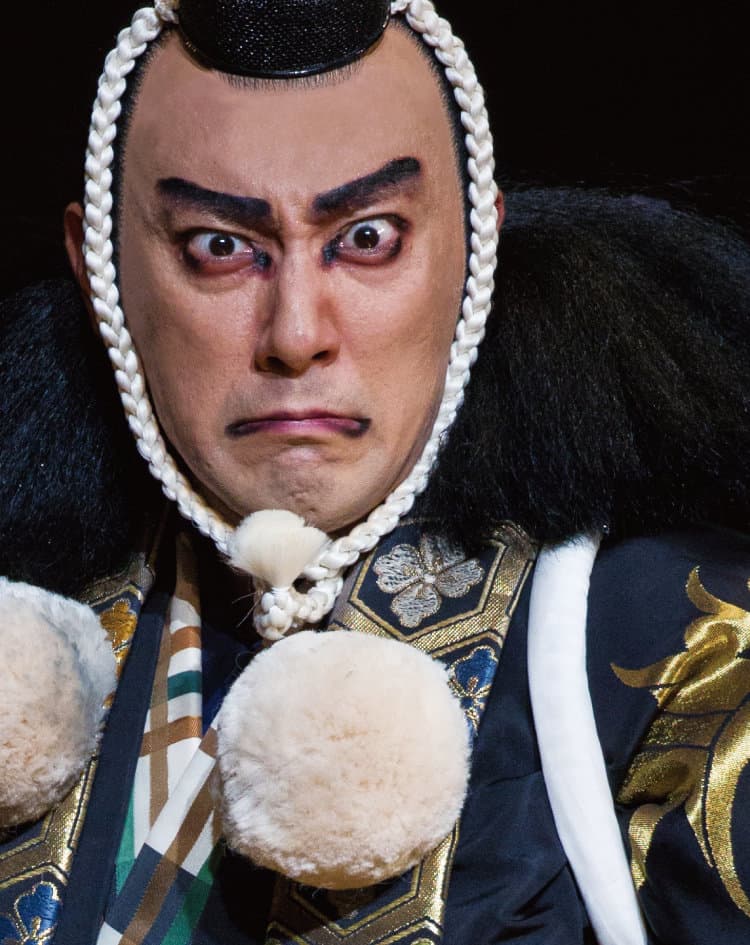
First, kumadori: face paint said to stylise veins and muscles. Red lines signify righteousness and courage; blue marks great villains and vengeful spirits; brown is for demons and other beings beyond the human. The character's essential nature reaches the audience at a single glance.
Next, costume and body. Aragoto costumes enlarge the human figure far beyond life size, and the actor moves in grand set forms such as the mie. At an emotional peak, all motion freezes: the actor locks into a pose, often crossing one eye. In that photograph-like stillness, shouts of appreciation fly from the audience.
And then the voice: lines delivered in a thunder that works less as information than as music. Your body registers 'overwhelming force' before your mind parses a word. Every element of aragoto is engineered toward that physical sensation.
Interpretation: What Lies Behind the Wildness
From here, our interpretation. The aragoto hero is not merely a strong man: he is often portrayed as a quasi-divine figure who drives out evil and shields the weak. For Edo audiences, we suspect, an aragoto performance was theatre and exorcism-festival at once — a time in which misfortune itself was swept from the room.
Seen this way, the 'wild' in aragoto is not the wildness of violence but of purification — a style built not to flaunt power but to offer it. Hold that thought, and the red of the kumadori and the stillness of the mie begin to look quite different.
Where to See It
The aragoto tradition survives most vividly in the Kabuki Jūhachiban, the eighteen plays of the Ichikawa Sōke. Shibaraku — whose hero halts an execution with a single offstage cry of 'Shibaraku!' ('Wait!') — and Sukeroku, which fuses Edo dandyism with aragoto power, are its most celebrated examples.
At the Ichikawa Danjūrō Special Performances at the Minamiza, Kyoto, in October 2026, the evening programme is planned around aragoto. Learn the style first, and every line of kumadori and every mie will read as a signal sent straight from Edo.
Related Terms & Plays
Related events
Oct 3, 2026 – Oct 25
Ichikawa Danjūrō Special Performances at the Minamiza, Kyoto
Minamiza Theatre
A special month at Kyoto's Minamiza theatre bringing Danjūrō and his son Shinnosuke together. The matinee features "Kanjinchō", one of kabuki's most celebrated plays; the evening bill centres on the bold aragoto piece "Dairiki Tenmusō". An ideal first visit to the historic Minamiza.
- Author
- KABUKI Universe Editorial Team
- Supervision
- Ichikawa Danjūrō
- Fact check
- KABUKI Universe Editorial Team
- Published
- Aug 15, 2026
- Updated
- Sep 8, 2026
- Verified
- Sep 8, 2026
Supervision means Ichikawa Danjūrō has reviewed this page's intent and key points. The text is the editorial team's writing, not Ichikawa Danjūrō's own statements. Editorial responsibility rests with the team, which corrects any error. Read the editorial policy
Sources
Corrections
- Sep 8, 2026In the description of kumadori colours, blue had been described as 'villainy or the uncanny'. Corrected to 'great villains and vengeful spirits' in line with the Japan Arts Council's digital library, and brown (demons and spirits) added.
- Sep 8, 2026The origin of aragoto had been placed 'in Genroku-era Edo'; both years given for its creation (1673 and 1685) precede the Genroku era, and the source itself says 'around the Genroku period', so the wording was changed to 'late-17th-century Edo (the Enpō to Genroku eras)'.