tachimawari
立廻り
たちまわりkabuki's stylized fight scenes
INSTANT ANSWER
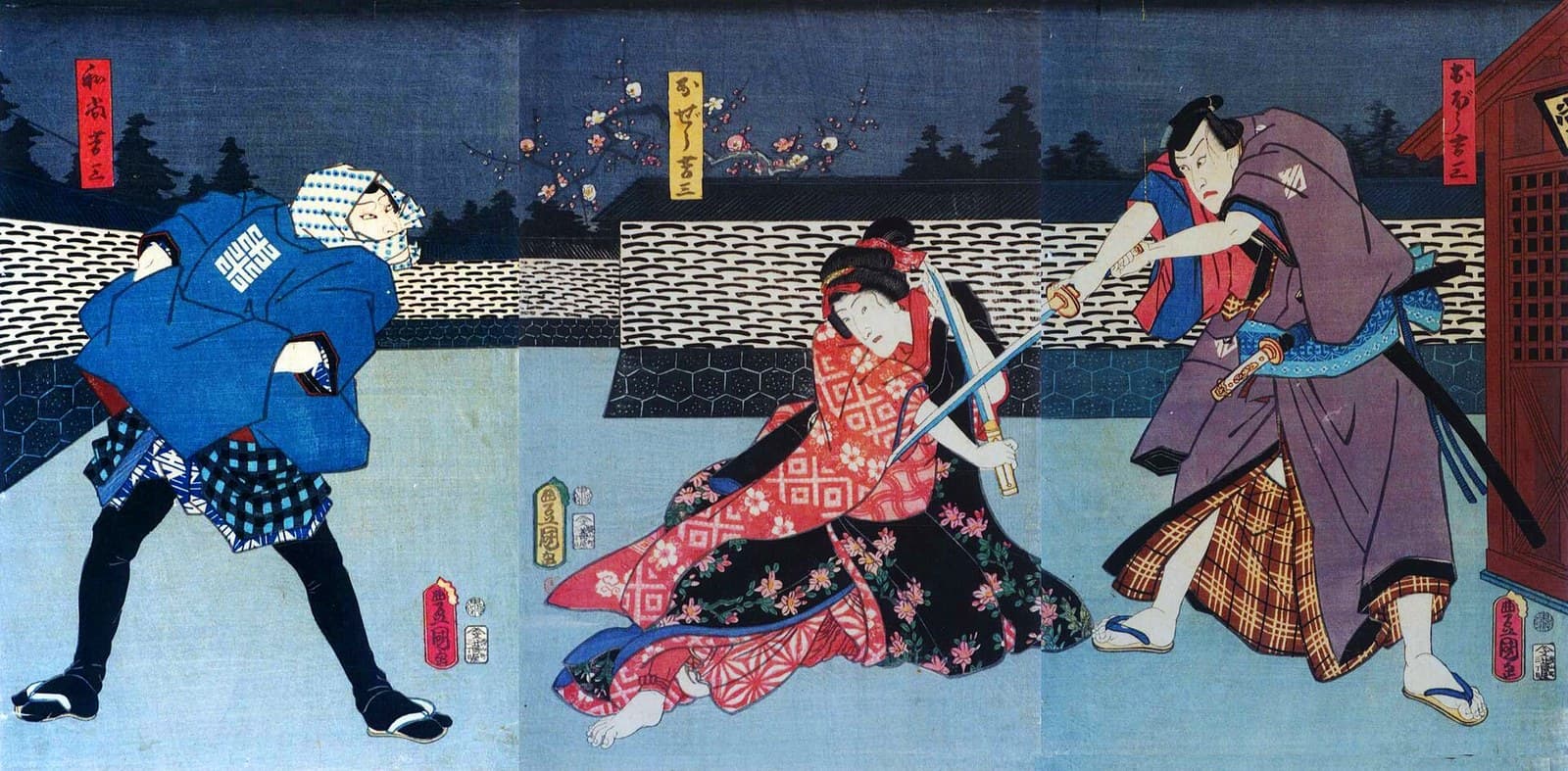
Tachimawari are kabuki's stylized fight scenes—group combat choreographed like dance to offstage music, punctuated by mie poses.
Tachimawari names the stylized staging of combat—battles, arrest scenes, murders, brawls. Rather than realistic fighting, the aim is beauty: the action flows like dance to offstage music, and the basic pattern sets a single hero against a crowd of constables or soldiers.
Its vocabulary of moves is said to be extensive. The choreography is called tate, devised and taught by specialist fight arrangers known as tateshi. The hero strikes mie at the peaks of the action, the vanquished turn somersaults, and the crack of the tsuke clappers binds it all into a single moving picture.
Tachimawari has entered everyday Japanese. To describe a flamboyant quarrel or a wild scuffle, people say someone "performed an ō-tachimawari"—a grand fight scene—the stage term carried straight into daily speech. That a stylized theatrical combat became the common metaphor for real-life struggle shows how deeply kabuki has marked the language of ordinary life.
On the stage of the Ichikawa Sōke (the head family of the Ichikawa Danjūrō lineage), whose house art is aragoto, the tachimawari is a central attraction. In Shibaraku, one of the Kabuki Jūhachiban, the hero famously takes on a crowd with an enormous sword—aragoto power and the stylized beauty of the fight scene made one.
Plays Where You Can See It
Read this next
These words meet on the same stage. Knowing one makes the next easier to see.
- トンボtonboTonbo is the somersault turned by a fighter who is "cut down" or thrown in a kabuki fight scene—a fundamental acrobatic skill of the actor's craft.Read
- 花四天hanayotenHanayoten are the flower-costumed constables and soldiers who swarm the hero in kabuki's most decorative fight scenes, bearing blossoming branches or flowered spears.Read
- 見得mieA mie is the stylized pose in which an actor freezes at a moment of peak emotion, punctuated by the sharp crack of wooden clappers.Read
- ツケtsukeTsuke are the sharp beats of wooden clappers struck against a board at the side of the stage, accenting footsteps and landing exactly on the frozen mie poses.Read
- 荒事aragotoAragoto is the bold, larger-than-life acting style—said to have been created by Ichikawa Danjūrō I—in which heroes express superhuman power through striking makeup, oversized costumes, and dramatic poses.Read
Sources & Supervision
- Author
- KABUKI Universe Editorial Team
- Supervision
- Ichikawa Danjūrō
- Published
- Aug 16, 2026
- Updated
- Sep 9, 2026
Supervision means Ichikawa Danjūrō has reviewed this page's intent and key points. The text is the editorial team's writing, not Ichikawa Danjūrō's own statements. Editorial responsibility rests with the team, which corrects any error. Read the editorial policy