shosagoto
所作事
しょさごとkabuki dance pieces
INSTANT ANSWER
Shosagoto are kabuki's dance pieces performed to live music—an art that began with onnagata and blossomed into a rich repertoire.
Shosagoto—also called furigoto—are pieces built around dance. The word shosa means expressive movement, and the genre is said to have emerged in the Genroku era as dance with a story. It began as the art of onnagata, who danced the course of love to nagauta music; in time, male-role actors joined them.
Masterpieces such as Kyōganoko Musume Dōjōji and Kagami Jishi represent the form, accompanied by nagauta, tokiwazu, or kiyomoto ensembles. Costume transformations like hikinuki and bukkaeri, unfolding mid-dance, are pleasures unique to shosagoto.
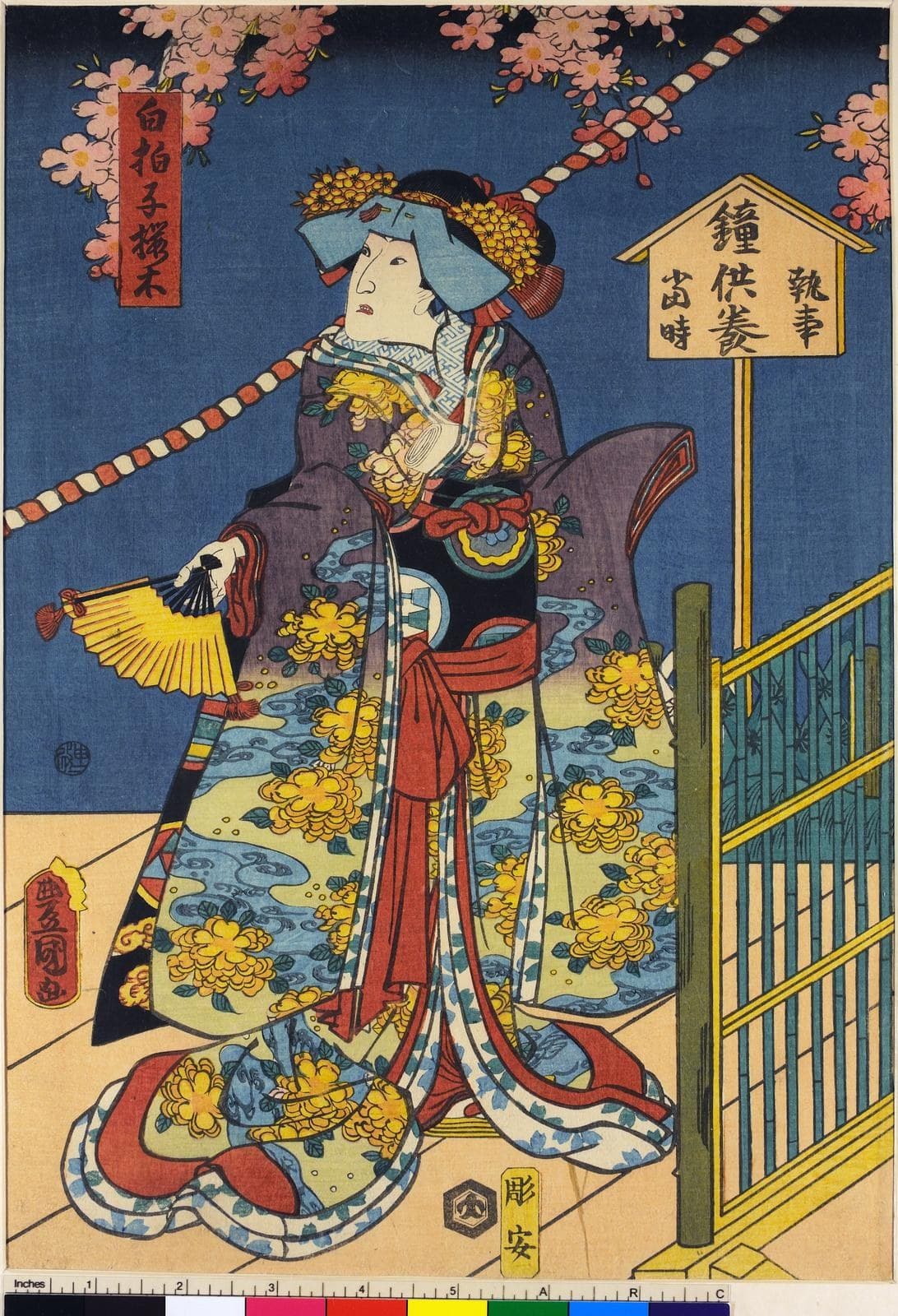
Kyōganoko Musume Dōjōji, honoured as the summit of the genre, is said to have been first danced in 1753 by Nakamura Tomijūrō I at the Nakamura-za in Edo. From the kudoki that pours out a girl's love to the hikinuki change into white robes for the dance with jingling suzudaiko—the shirabyōshi Hanako's dance weaves in every element of the onnagata's art, surveying the riches of shosagoto within a single work.
For the Danjūrō family, the great example is Kanjinchō—premiered by Danjūrō VII on a Noh model—which stands at the heart of the Kabuki Jūhachiban as a dignified dance drama. The house of aragoto has left deep footprints in the world of dance as well.
Plays Where You Can See It
Read this next
These words meet on the same stage. Knowing one makes the next easier to see.
- 松羽目物matsubamemonoMatsubamemono are dignified pieces adapted from Noh and Kyōgen, performed before a pine-panel set modeled on the Noh stage—a genre said to begin with Kanjinchō.Read
- 道行michiyukiA michiyuki is a poetic travel scene, usually danced, that follows two figures—most often lovers—on their journey.Read
- 引抜hikinukiHikinuki is the on-stage quick change: basting threads are pulled away to transform a costume in an instant, before the audience's eyes.Read
- ぶっ返りbukkaeriBukkaeri is the costume trick in which the upper garment drops and folds down at the waist, instantly revealing a character's true identity.Read
- 女方onnagataAn onnagata is a male actor who specializes in female roles, creating an idealized femininity through stylized movement, voice, and costume rather than realistic imitation.Read
Sources & Supervision
- Author
- KABUKI Universe Editorial Team
- Supervision
- Ichikawa Danjūrō
- Published
- Aug 15, 2026
- Updated
- Sep 9, 2026
Supervision means Ichikawa Danjūrō has reviewed this page's intent and key points. The text is the editorial team's writing, not Ichikawa Danjūrō's own statements. Editorial responsibility rests with the team, which corrects any error. Read the editorial policy