shiranami-mono
白浪物
しらなみものkabuki's "thief plays"
INSTANT ANSWER
Shiranami-mono are kabuki's "thief plays"—dramas with charismatic robbers as their heroes, which flourished at the end of the Edo period, above all in the work of Kawatake Mokuami.
Shiranami-mono is the collective name for kabuki plays whose protagonists are thieves. Shiranami—"white waves"—is an old euphemism for robbers, said to derive from the "White Wave bandits" of Later Han China who hid in the White Wave valley. Placing outlaws of duty and feeling at center stage, the genre mirrors the temper of the late Edo period.
The playwright most identified with the genre is Kawatake Mokuami. His Aoto Zōshi Hana no Nishiki-e—known as Shiranami Gonin Otoko, "The Five Thieves"—is said to have premiered at the Ichimura-za in Edo in 1862, and the roll-call speeches of its five robbers, led by Benten Kozō, remain beloved showpieces of flowing stage language.
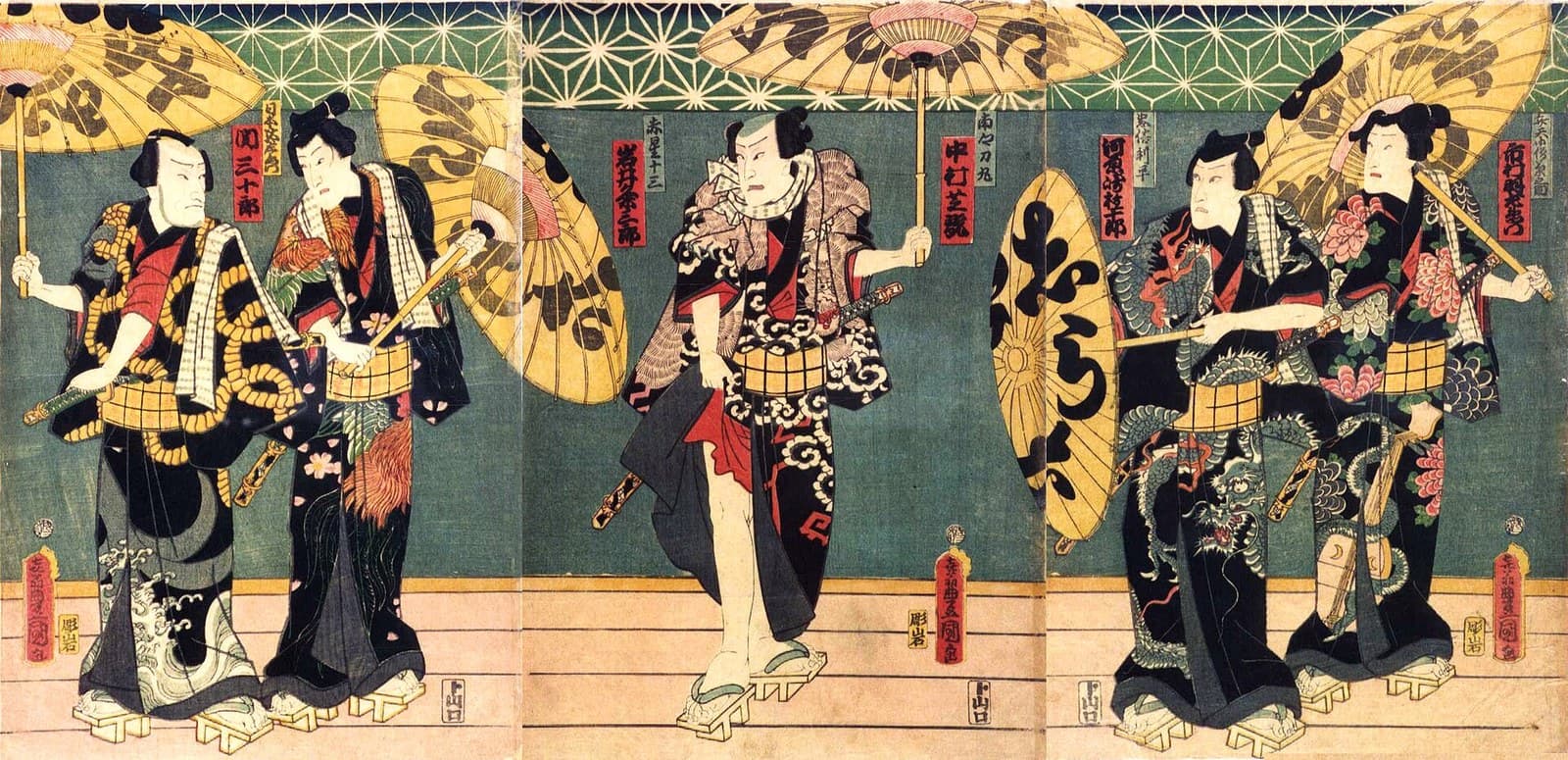
The pleasures of the genre are distilled in two scenes of Shiranami Gonin Otoko: "Hamamatsuya" and the assembly at the Inase River. Benten Kozō, caught posing as a samurai's daughter to blackmail a dry-goods store, drops the disguise with the celebrated declaration in 7-5 meter beginning "Shirazā itte kikaseyashō"—"If you don't know me, let me tell you"—one of kabuki's great set-piece speeches. In the assembly scene that follows, the five thieves line up, umbrellas in hand, each announcing himself in turn.
Shiranami-mono belong to kabuki as a whole rather than to any single house. Mokuami is said to have written many of his raw domestic plays for Ichikawa Kodanji IV in the last years of Edo, and later to have supplied works to Ichikawa Danjūrō IX in the Meiji era—his pen deeply entwined with actors bearing the Ichikawa name.
Plays Where You Can See It
- Aotozōshi Hana no NishikieThe Five Thieves (Aotozōshi Hana no Nishikie)Under their chief Nippon Daemon, five thieves—Benten Kozō Kikunosuke, Tadanobu Rihei, Akaboshi Jūzaburō and Nangō Rikimaru—prey on Edo.View play
- Sannin Kichisa Tomoe no ShiranamiThe Three Kichisas (Sannin Kichisa Tomoe no Shiranami)Ojō Kichisa in a young woman's robes, Obō Kichisa the masterless samurai, Oshō Kichisa the former priest: three thieves who share a name meet on the bank of the Sumida.View play
Read this next
These words meet on the same stage. Knowing one makes the next easier to see.
- 生世話物kizewamonoKizewamono are the most sharply realistic of kabuki's domestic plays, depicting the raw life and lower depths of the Edo townsman's world.Read
- 世話物sewamonoSewamono are plays of ordinary townspeople in the Edo period—dramas of love, duty, and scandal drawn close to real life.Read
- 怪談物kaidan-monoKaidan-mono are kabuki's ghost plays, traditionally staged in summer; Tsuruya Nanboku's Tōkaidō Yotsuya Kaidan stands as the genre's masterpiece.Read
Sources & Supervision
- Author
- KABUKI Universe Editorial Team
- Supervision
- Ichikawa Danjūrō
- Published
- Aug 16, 2026
- Updated
- Sep 9, 2026
Supervision means Ichikawa Danjūrō has reviewed this page's intent and key points. The text is the editorial team's writing, not Ichikawa Danjūrō's own statements. Editorial responsibility rests with the team, which corrects any error. Read the editorial policy