Edo sanza
江戸三座
えどさんざthe three licensed theatres of Edo
INSTANT ANSWER
The Edo sanza were the three officially licensed playhouses of Edo—the Nakamura-za, Ichimura-za, and Morita-za—the heart of Edo kabuki until the Meiji era.
The Edo sanza are the three playhouses licensed to stage kabuki in Edo: the Nakamura-za, Ichimura-za, and Morita-za. In the Genroku era there had been four, but after the Ejima-Ikushima affair of 1714 led to the abolition of the Yamamura-za, performance rights are said to have been restricted to these three until the Meiji era.
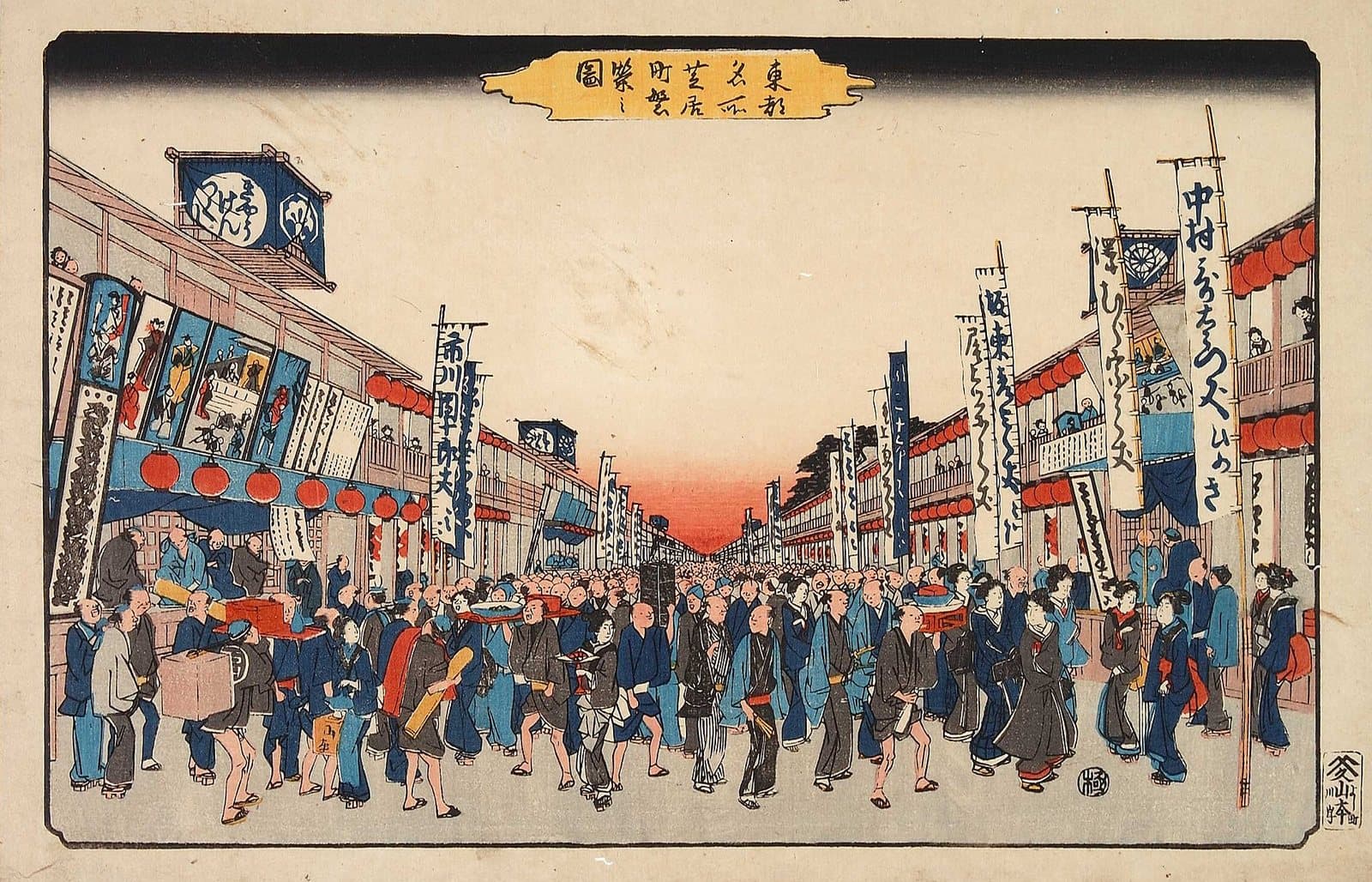
Under the Tenpō Reforms, and following the fire of 1841, the three theatres were ordered out and relocated in 1842-43 to Shōtenchō in Asakusa, renamed Saruwaka-machi. There, until the Meiji era, the district remained the capital of Edo kabuki, and playgoing an indispensable pleasure of Edo life.
Saruwaka-machi, the town to which the three theatres moved, preserves the memory of Edo kabuki in its very name: it honors Saruwaka (Nakamura) Kanzaburō I, said to have raised Edo's first theatre tower in 1624, and the three houses were also called the Saruwaka sanza. Lined with theatre teahouses and actors' homes, the district is said to have been among the liveliest sights in Edo.
It was on the stages of these three theatres that successive Ichikawa Danjūrō, from the first onward, made their names. The aragoto style of Edo itself was nurtured beneath the sanza's towers, together with their audiences—the history of the Edo sanza and that of the Ichikawa Sōke's art are inseparably entwined.
Plays Where You Can See It
Read this next
These words meet on the same stage. Knowing one makes the next easier to see.
- 櫓yaguraThe yagura is the tower structure raised above a playhouse entrance—once the exclusive mark of an officially licensed theatre and the symbol of its right to perform.Read
- 座頭zagashiraThe zagashira is the actor at the head of a troupe—supreme in both artistry and standing, who in the Edo period wielded authority over the stage and the company alike.Read
- 顔見世kaomiseKaomise is the annual "face-showing" production that introduced a theatre's newly assembled troupe—once the most important event of the kabuki year.Read
- 千両役者senryō yakushaA senryō yakusha is an actor whose popularity commanded a yearly salary of a thousand ryō—Ichikawa Danjūrō II is counted among the first to earn the title.Read
Sources & Supervision
- Author
- KABUKI Universe Editorial Team
- Supervision
- Ichikawa Danjūrō
- Published
- Aug 16, 2026
- Updated
- Sep 9, 2026
Supervision means Ichikawa Danjūrō has reviewed this page's intent and key points. The text is the editorial team's writing, not Ichikawa Danjūrō's own statements. Editorial responsibility rests with the team, which corrects any error. Read the editorial policy