From Tenpō into Kaei
The Eighth
Ichikawa Danjūrō VIII
The idol whose popularity brought Saruwaka-machi back to life
- Life
- 1823–1854
- Bore the name Danjūrō
- 1832–1854
- Age at succession
- 10
- Earlier and literary names
- Ichikawa Shinnosuke (his name at his first appearance) · Ichikawa Ebizō VI
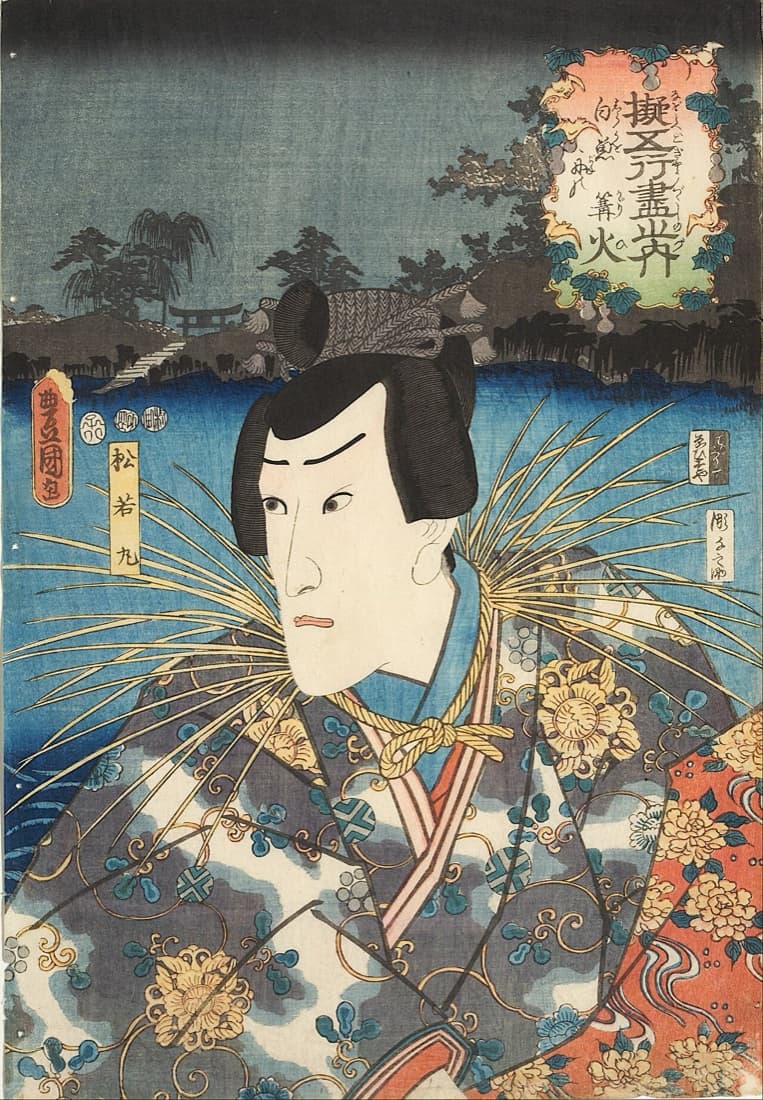
This generation in thirty seconds
In the third month of 1832, at ten, he became Danjūrō VIII. Long-faced and strikingly handsome, carrying a stylish, refined sensuality and a high, ringing delivery, he built a Danjūrō unlike those before him. After the Tenpō Reforms drove the three great Edo theatres out to Saruwaka-machi, it was his popularity above all — so the Naritaya official site records — that drew the crowds back. In the eighth month of 1854, in Osaka, he took his own life, at thirty-two.
What he inherited
Taking the name at ten, as the eighteen plays were named
In the third month of 1832, at ten, he took the name Danjūrō VIII at the Ichimuraza. On the same occasion his father became Ebizō V and published Kabuki Kyōgen-gumi Jūhachiban, a printed sheet naming eighteen plays drawn from those held by the Ichikawa house. His succession and the first setting-down of the family repertoire were events of the same stage.
On stage at barely a month old
The Naritaya official site records that in 1823, barely a month old, he was carried onto the Ichimuraza kaomise stage as Shinnosuke, in the role of Arawakamaru, child of Usui Sadamitsu. In the tenth month of 1825, at three, he gave the name Shinnosuke to a newborn brother and took the name Ebizō VI.
The Naritaya official site records his performance of the mizuiri scene in Sukeroku — one of the eighteen plays, and a piece handed down in the Ichikawa house.
What he created, changed or revived
A Danjūrō who looked unlike his forebears
The Naritaya official site records that he was long-faced and exceptionally handsome, with a bearing of a different type from the Danjūrō before him: stylish, refined, sensual, yet never cloying, and engaging even in repose. In a house built on aragoto, here was a head of the line whose appeal lay elsewhere than in bulk and force.
A high, carrying voice
His voice, the Naritaya official site relates, was said to run high and clear, fresh and full-throated — a celebrated delivery. A vocal appeal quite unlike the heavy, thick production of aragoto appears to have been one ground of his popularity.
The première of the Kiyomoto dance Ochiudo
The Naritaya official site records that the Kiyomoto dance Ochiudo was first performed by him, and that the word 'Hakuen' in its text plays on his father's poetry name. The lyrics were by Mimasuya Nisōji, a devotee of Danjūrō VII; the piece is still frequently danced today.
Signature roles and plays
The Naritaya official site relates the rumours that attached to the water in the rain-barrel he used for the mizuiri scene in Sukeroku. One of the eighteen plays.
Ochiudo
The Naritaya official site records him as the first to dance this piece. The line in which Okaru looks at Kanpei's face and sings of a print resembling 'Hakuen' plays on his father's poetry name.
Danjūrō Musume, known as Ōmi no Okane
The Naritaya official site describes this as one of an eight-transformation dance suite built by Danjūrō VII in 1813 on the eight views of Ōmi, and records that both the eighth and the ninth of the line danced it. It sets to nagauta the tale of a girl of great strength by Lake Biwa who subdued a wild horse without stepping out of her clogs.
Kabuki in his age
The twenty-two years in which he bore the name were the years in which the Tenpō Reforms bore down on the Edo theatre. The Cultural Digital Library records that the hardliners around the senior councillor Mizuno Tadakuni wanted kabuki abolished outright; Tōyama Kagemoto and others resisted, and in the end a fire provided the occasion for a compromise — the three great theatres would be moved out to Asakusa. The removals were completed between 1841 and 1843, and in the new theatre town named Saruwaka-machi the puppet playhouses stood alongside them. The thirty years that followed, down to the early Meiji period, are known as the Saruwaka-machi age. Edo kabuki lost the festival glow of the kaomise openings in these years, but its traffic with the variety halls and sideshows grew busier.
Meanwhile, in the world
- 1841–1843Society
The Tenpō Reforms, and the policing of amusement
The Cultural Digital Library records that the Tenpō Reforms of 1841–43 aimed at shoring up the shogunal order, and that as part of this luxury was policed exhaustively — costly ornaments and food, novels and colour prints all restricted as extravagance. Popular amusements such as the theatre and the variety halls were heavily curtailed.
- 1841–1843Society
The three Edo theatres move to Saruwaka-machi
The Cultural Digital Library records that moderates blocked the hardliners' plan to abolish kabuki, and that a fire gave the occasion for the settlement reached instead: the playhouses were moved from central Edo out to Asakusa, then still on the city's edge. The removals were completed between 1841 and 1843, and a new theatre town named Saruwaka-machi came into being.
- —Art & plays
The kaomise fades as the variety halls thrive
Of Edo kabuki in these years the Cultural Digital Library records that the eleventh-month kaomise, once praised as the flower of Edo, went into decline: the actors' change-over shifted to the first month and the festival air went out of the openings. Meanwhile the variety halls and sideshows grew busier as easy entertainment, and their material began to feed kabuki in turn.
Where the age and the actor meet
- 1842–1849Society
His father's banishment, and a daily walk to the Fudō
The Naritaya official site records that he was known for filial devotion: during his father's banishment he abstained each morning and walked daily to the Kuramae shrine of the Narita Fudō to pray for his father's safety and pardon. He is said to have been commended for it by the city magistrate and given ten kanmon in coin — a point at which the reforms that squeezed kabuki and the devotions of the house intersect.
- 1842Art & plays
Drawing the audience back to Saruwaka-machi
The Naritaya official site records that when the three Edo theatres were forcibly removed to Saruwaka-machi in Asakusa, away from the centre, attendance fell at first — but that before long the crowds returned in greater numbers than before, and that the driving force behind this was, in large part, his popularity.
- —Media
When a popularity itself goes on sale
The Naritaya official site relates that water from the rain-barrel he used for the mizuiri scene in Sukeroku was rumoured to confer beauty if used to mix one's face powder, and sold briskly at a bu the flask; and that there was a legend of ladies of the great houses keeping his expectorate, labelled as such, in brocade amulet pouches worn against the skin. The site presents both as rumour and legend, and they are recorded here on the same footing.
- 1854–1854Society
The journey to Osaka, and his death
In the sixth month of 1854 he left Edo to visit his father, then in Osaka, joining him mid-run in Nagoya and appearing on stage there. On 28 July the two made their ceremonial boat entry to the Dōtonbori theatre. On the morning of 6 August, the opening day in Osaka, he took his own life at an inn in Shimanouchi Gozenchō, at thirty-two. The Naritaya official site states that the cause is unknown.
From this generation to the next
After his death the name Danjūrō stood empty for some twenty years, the Cultural Digital Library records, until the ninth of the line took it in 1874. His popularity did not fade with him: more than three hundred varieties of memorial print were published. The sheer number is what now conveys the scale of the attention Edo had fixed on a single actor.
Where the sources differ
On the following points the sources we consulted disagree. Rather than declare one correct, we set them side by side and state how we have handled each.
When the three Edo theatres are said to have moved to Saruwakachō
The move was completed at some point between 1841 and 1843 — the account gives a span rather than a year.
Source: 独立行政法人日本芸術文化振興会 文化デジタルライブラリー「黙阿弥」歌舞伎をめぐる動き(江戸三座、猿若町へ移転)
The suppression of kabuki under the Tenpō reforms is placed in a single year, 1842.
How we handle it
The two sources fix the date to different degrees of precision. Our text follows the span, 1841 to 1843, rather than pinning the move to one year.
What remains today
More than three hundred memorial prints
The Naritaya official site records that his popularity did not decline after his death, and that more than three hundred varieties of shinie, memorial prints, were published — a record of the scale on which one actor's death moved the publishers of Edo.
The Kiyomoto dance Ochiudo
The dance he is recorded as having first performed. It remains frequently staged today.
From his death until the succession of Danjūrō IX in 1874, the Cultural Digital Library records, the name went some twenty years unborne — a reminder that the line has not run unbroken.